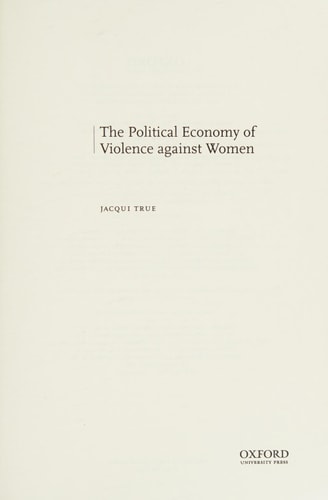
The Political Economy of Violence against Women (Oxford Studies in Gender and International Relations)
0
0
As an Amazon Associate and affiliate partner, Menrva Books earns from qualifying purchases. Learn more
Author Description
Violence against women is a major problem in all countries, affecting women in every socio-economic group and at every life stage. Nowhere in the world do women share equal social and economic rights with men or the same access as men to productive resources. Economic globalization and development are creating new challenges for women's rights as well as some new opportunities for advancing women's economic independence and gender equality. Yet, when women have access to productive resources and they enjoy social and economic rights they are less vulnerable to violence across all societies. The Political Economy of Violence against Women develops a feminist political economy approach to identify the linkages between different forms of violence against women and macro structural processes in strategic local and global sites - from the household to the transnational level. In doing so, it seeks to account for the globally increasing scale and brutality of violence against women. These sites include economic restructuring and men's reaction to the loss of secure employment, the abusive exploitation associated with the transnational migration of women workers, the growth of a sex trade around the creation of free trade zones, the spike in violence against women in financial liberalization and crises, the scourge of sexual violence in armed conflict and post-crisis peacebuilding or reconstruction efforts and the deleterious gendered impacts of natural disasters. Examples are drawn from South Africa, Kenya, the Democratic Republic of Congo, China, Ciudad Juarez in Mexico, the Pacific Islands, Argentina, Eastern Europe, Central Asia, Haiti, Sri Lanka, Indonesia, New Zealand, Ireland, the United Kingdom, the United States and Iceland.
Menrva's Summary
THE THESIS
This work investigates the causal relationship between macro-structural economic processes and the global prevalence of violence against women. Jacqui True, a professor of International Relations, utilizes a feminist political economy framework to analyze how globalization, economic restructuring, and financial crises exacerbate gender-based violence. By examining sites ranging from the household to transnational institutions, the author argues that economic inequality and the denial of women's rights are primary drivers of physical and systemic abuse.
THE SCOPE MAP
What You Will Find
- Analysis of the link between economic liberalization and increased rates of sexual violence.
- Examination of gendered impacts during armed conflict, post-crisis reconstruction, and natural disasters.
- Case studies spanning diverse regions including South Africa, China, Mexico, and the United Kingdom.
- A theoretical framework connecting transnational migration, sex trade growth, and household economic security.
THE AUTHORITY PERSPECTIVE
Scholars and policy analysts recognize this text as a foundational contribution to the study of gendered violence within international political economy. Readers frequently note the academic density of the prose and the breadth of the global case studies provided.
Page Count:
242
Publication Date:
2012-08-28
Publisher:
Oxford University Press
ISBN-10:
0199755914
ISBN-13:
9780199755912
Economics
Human rights
Women And War
International relations
Sex Discrimination Against Women
Sociology
Crimes Against
Gender Studies
Sex Crimes
Women
Community Tags
Similar Books