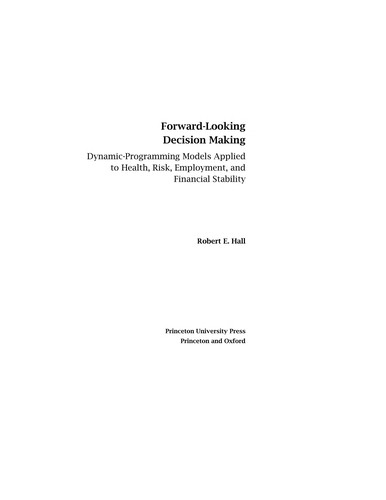
Forward-Looking Decision Making
0
0
As an Amazon Associate and affiliate partner, Menrva Books earns from qualifying purchases. Learn more
Author Description
Individuals and families make key decisions that impact many aspects of financial stability and determine the future of the economy. These decisions involve balancing current sacrifice against future benefits. People have to decide how much to invest in health care, exercise, their diet, and insurance. They must decide how much debt to take on, and how much to save. And they make choices about jobs that determine employment and unemployment levels. Forward-Looking Decision Making is about modeling this individual or family-based decision making using an optimizing dynamic programming model. Robert Hall first reviews ideas about dynamic programs and introduces new ideas about numerical solutions and the representation of solved models as Markov processes. He surveys recent research on the parameters of preferences - the intertemporal elasticity of substitution, the Frisch elasticity of labor supply, and the Frisch cross-elasticity. He then examines dynamic programming models applied to health spending, long-term care insurance, employment, entrepreneurial risk-taking, and consumer debt. Linking theory with data and applying them to real-world problems. Forward-Looking Decision Making uses dynamic optimization programming models to shed light on individual behaviors and their economic implications.--Jacket.
Menrva's Summary
THE THESIS
This book models individual and family financial decision-making using optimizing dynamic programming models. Robert Hall, a noted economist, explores how people balance current sacrifices against future benefits when making crucial choices about healthcare, diet, insurance, debt, savings, and employment. The book details the theoretical framework, including dynamic programs and numerical solutions, and then applies these models to real-world economic behaviors.
THE SCOPE MAP
- Review of dynamic programming concepts and numerical solutions.
- Introduction to Markov processes for representing solved models.
- Survey of recent research on preference parameters (intertemporal elasticity of substitution, Frisch elasticities).
- Application of dynamic programming models to health spending and long-term care insurance.
- Analysis of decision-making related to employment and entrepreneurial risk-taking.
- Examination of consumer debt models.
- Linking economic theory with data for real-world problem-solving.
THE AUTHORITY PERSPECTIVE
The book applies advanced economic modeling techniques to everyday financial decisions, offering a rigorous approach to understanding individual economic behavior. Its focus on dynamic optimization programming suggests a text geared towards academics and advanced students in economics or finance. The integration of theory with empirical data aims to provide practical insights into personal financial choices and their broader economic implications.
Page Count:
126
Publication Date:
2010-01-01
ISBN-10:
0691142424
ISBN-13:
9780691142425
Personal Development
Non-Fiction
Economics
Finance
Community Tags
Similar Books