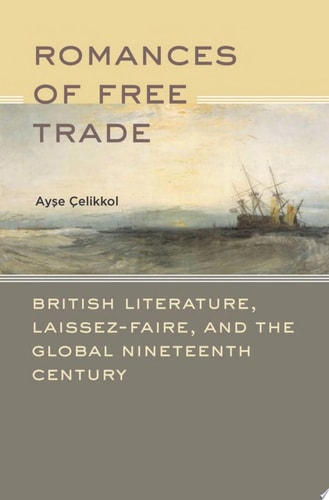
Romances of Free Trade: British Literature, Laissez-Faire, and the Global Nineteenth Century
0
0
As an Amazon Associate and affiliate partner, Menrva Books earns from qualifying purchases. Learn more
Author Description
Exploring works by Walter Scott, Harriet Martineau, Charlotte Brontë, Charles Dickens, and their lesser-known contemporaries, Romances of Free Trade historicizes globalization as it traces the perception of dissolving borders and declining national sovereignty back into the nineteenth century.The book offers a new account of the cultural work of romance in nineteenth-century Britain. Çelikkol argues that novelists and playwrights employed this genre to represent a radically new historical formation: the emergence of a globalized free-market economy. In previous centuries, the British state had pursued an economic policy that chose domestic goods over foreign ones. Through the first half of the nineteenth century, liberal economists maintained that commodity traffic across national borders should move outside the purview of the state, a position and practice that began to take hold as the century progressed. Amid the transformation, Britons pondered the vertiginous effects of rapidly accelerating economic circulation. Would patriotic attachment to the homeland dissolve along with the preference for domestic goods? How would the nation and the empire fare if commerce became uncontrollable? The literary genre of romance, characterized by protagonists who drift in lawless spaces, played a meaningful role in addressing such pressing questions. From the figure of the smuggler to the episodic plot structure, romance elements in fiction and drama narrated and made tangible the sprawling global markets and fluid capital that were reshaping the world.In addition to clear-eyed close readings of nineteenth-century novels and plays, Çelikkol draws on the era's major economic theorists, figures like Adam Smith and Thomas Malthus, to vividly illustrate the manifold ways the romance genre engaged with these emerging financial changes.
Menrva's Summary
THE THESIS
This work investigates how the literary genre of romance served as a primary vehicle for representing and navigating the emergence of a globalized free-market economy in nineteenth-century Britain. Ayse Çelikkol, a scholar of Victorian literature, synthesizes economic theory with literary analysis to demonstrate how authors utilized the conventions of romance to conceptualize the shifting boundaries of national sovereignty. By examining the intersection of liberal economic thought and narrative form, the author argues that the fluidity of the romance genre provided a framework for Britons to process the rapid acceleration of global capital and the decline of protectionist trade policies.
THE SCOPE MAP
What You Will Find
- Analysis of major nineteenth-century authors including Walter Scott, Harriet Martineau, Charlotte Brontë, and Charles Dickens.
- Integration of economic theories from figures such as Adam Smith and Thomas Malthus.
- Examination of literary devices like episodic plot structures and the figure of the smuggler.
- Historical context regarding the transition from domestic-focused economic policy to globalized free trade.
THE AUTHORITY PERSPECTIVE
Scholars frequently note the effectiveness of this text in bridging the gap between economic history and literary studies. Experts highlight the book as a significant contribution to understanding how nineteenth-century fiction reflected the anxieties of a rapidly globalizing world.
Page Count:
208
Publication Date:
2011-07-29
Publisher:
Oxford University Press
ISBN-10:
0199769001
ISBN-13:
9780199769001
History
Economics
British literature
Authors english
Nineteenth century
Literary Criticism
Community Tags
Similar Books