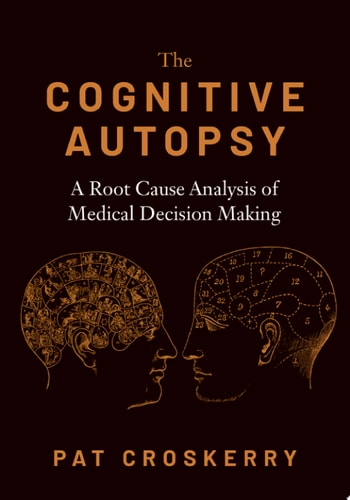
The Cognitive Autopsy
0
0
As an Amazon Associate and affiliate partner, Menrva Books earns from qualifying purchases. Learn more
Author Description
Behind Heart Disease And Cancer, Medical Error Is Now Listed As One Of The Leading Causes Of Death. Of The Many Medical Errors That May Lead To Injury And Death, Diagnostic Failure Is Regarded As The Most Significant. Generally, The Majority Of Diagnostic Failures Are Attributed To The Clinicians Directly Involved With The Patient, And To A Lesser Extent, The System In Which They Work. In Turn, The Majority Of Errors Made By Clinicians Are Due To Decision Making Failures Manifested By Various Departures From Rationality. Of All The Medical Environments In Which Patients Are Seen And Diagnosed, The Emergency Department Is The Most Challenging. It Has Been Described As A Wicked Environment Where Illness And Disease May Range From Minor Ailments And Complaints To Severe, Life-threatening Disorders. The Cognitive Autopsy Is A Novel Strategy Towards Understanding Medical Error And Diagnostic Failure In 42 Clinical Cases With Which The Author Was Directly Involved Or Became Aware Of At The Time. Essentially, It Describes A Cognitive Approach Towards Root Cause Analysis Of Medical Adverse Events Or Near Misses. Whereas Root Cause Analysis Typically Focuses On The Observable And Measurable Aspects Of Adverse Events, The Cognitive Autopsy Attempts To Identify Covert Cognitive Processes That May Have Contributed To Outcomes. In This Clinical Setting, No Cognitive Process Is Directly Observable But Must Be Inferred From The Behavior Of The Individual Clinician. The Book Illustrates Unequivocally That Chief Among These Cognitive Processes Are Cognitive Biases And Other Flaws In Decision Making, Rather Than Knowledge Deficits.
Menrva's Summary
THE THESIS
The book investigates the prevalence of diagnostic failure in clinical settings by proposing the 'cognitive autopsy' as a method to identify the underlying decision-making errors that lead to medical adverse events. Pat Croskerry, an expert in emergency medicine and clinical decision-making, utilizes his extensive experience to analyze 42 specific clinical cases. He argues that most diagnostic errors stem from cognitive biases and flaws in reasoning rather than simple knowledge deficits, providing a framework for clinicians to perform root cause analysis on their own thought processes.
THE SCOPE MAP
What You Will Find
- A detailed framework for conducting a cognitive autopsy on medical adverse events.
- Analysis of 42 real-world clinical cases involving diagnostic failure.
- Identification of common cognitive biases and decision-making traps in emergency medicine.
Scope Limits
- The text focuses primarily on the individual clinician's cognitive processes rather than systemic or institutional policy failures.
- It does not provide a comprehensive guide to clinical diagnostic protocols for specific diseases.
THE AUTHORITY PERSPECTIVE
Experts in medical education and emergency medicine recognize this work as a significant contribution to the study of clinical reasoning and patient safety. Readers frequently note the academic density of the prose, which is intended for practicing clinicians and medical educators seeking to improve diagnostic accuracy.
Page Count:
224
Publication Date:
2020-01-01
Publisher:
Oxford University Press
ISBN-10:
0190088753
ISBN-13:
9780190088750
Psychology
Medical
Professional Development
Decision Making
Emergency medicine
Community Tags
Similar Books