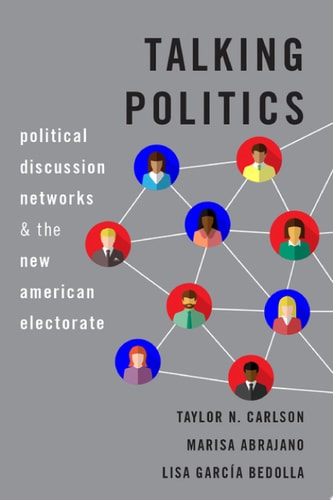
Talking Politics: Political Discussion Networks and the New American Electorate
0
0
As an Amazon Associate and affiliate partner, Menrva Books earns from qualifying purchases. Learn more
Author Description
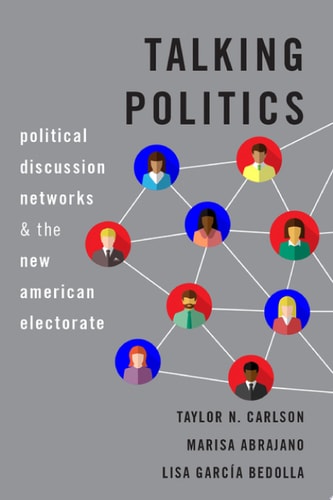
Over five decades of research has made clear that social networks can have an important impact on our political behavior. Specifically, when we engage in political conversation within these networks we develop connections that increase the likelihood that we will become politically active. Yet, most studies of political behavior focus on individuals, rather than the effects of networks on political behavior. Furthermore, any studies of networks have, by and large, been based on White Americans. Given what we know about the ways in which neighborhood, cultural, friend, and family networks tend to segregate along ethnic and racial lines, the authors of this book argue that we can assume that political networks segregate in much the same way.This book draws on quantitative and qualitative analyses of 4000 White American, African American, Latino, and Asian American people to explore inter and intra-ethnoracial differences in social network composition, size, partisanship, policy attitudes, and homophily in political and civic engagement. The book thus makes three key contributions: 1) it provides, for the first time, detailed comparative analysis of how political networks vary across and within ethnoracial groups; 2) demonstrates how historical differences in partisanship, policy attitudes, and engagement are reflected within groups' social networks; and, 3) reveals the impact that networks can have on individuals' political and civic engagement.
Menrva's Summary
THE THESIS
This book investigates how social network composition and political discussion patterns vary across different ethnoracial groups in the United States and how these networks influence individual political behavior. The authors, Marisa Abrajano, Taylor N. Carlson, and Lisa García Bedolla, utilize a multi-methodological approach to challenge the traditional focus on individual-level political behavior. By examining the intersection of race, ethnicity, and social connectivity, they argue that political networks are deeply segregated and that these structures significantly shape partisanship and civic participation.
THE SCOPE MAP
What You Will Find
- Comparative analysis of political networks among White, African American, Latino, and Asian American populations.
- Quantitative and qualitative data derived from a study of 4,000 participants.
- Examination of homophily, network size, and policy attitudes within diverse social circles.
Scope Limits
- The study focuses primarily on the American electorate and does not extend to international political network structures.
- The research does not provide a comprehensive history of political party formation, focusing instead on the social mechanisms of political discussion.
THE AUTHORITY PERSPECTIVE
Experts recognize this work as a significant expansion of political behavior research by incorporating diverse racial and ethnic perspectives into network theory. Readers frequently note that the text provides a rigorous, data-driven framework for understanding how social segregation impacts modern political engagement.
Page Count:
252
Publication Date:
2020-05-11
Publisher:
Oxford University Press
ISBN-10:
0190082119
ISBN-13:
9780190082116
Sociology
American Politics
Race & Ethnicity
Social Networks