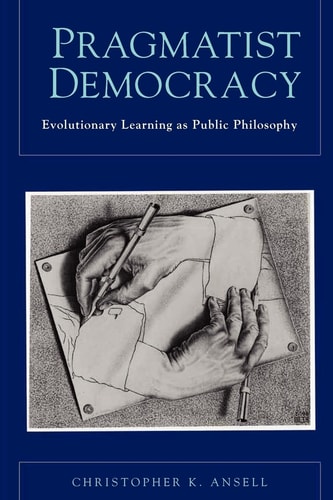
Pragmatist Democracy: Evolutionary Learning as Public Philosophy
0
0
As an Amazon Associate and affiliate partner, Menrva Books earns from qualifying purchases. Learn more
Author Description
Barack Obama is often lauded as a 'pragmatist,' yet when most people employ the term, they mean it in the vaguest sense: that he's practical and willing to compromise to get things done. However, the public philosophy of pragmatism, which has been the subject of a rich revival in the past couple of decades, is far more than this. First developed in the late nineteenth century, pragmatism is primarily a way of thinking--an anti-dualist philosophy that attempts to overcome the dichotomies between self and object, nature and culture, mind and body, theory and practice, and fact and value. When applied to governance, pragmatists advocate the use of tactics like third party mediation and problem-solving to achieve anti-dualist principles: cosmopolitan localism, analytical holism, progressive conservatism, and processual structuralism.In Pragmatist Governance, Chris Ansell begins with a theory of the concept and then explains why the approach is ideal for addressing today's governance problems. For instance, while many think that bureaucracy's unchecked growth is the fundamental problem facing democracy today, pragmatism suggests the opposite: that public agencies can effectively manage the relationship between governance and democracy if they focus on building consent for public problem-solving. Ansell argues that wishing away bureaucracy will not do given what we know about the indispensible role of institutions in contemporary governance. Utilizing pragmatist concepts, Ansell rethinks the design of institutions, arguing that they are neither the simple products of rational design that can be endlessly tinkered with nor 'congealed taste'--where institutions represent the timeless customs and values of a people. Along with overcoming this dualism, Ansell also challenges us to rethink our approach to governance. Instead of moving from one extreme to the other--from bureaucracy to 'post-bureaucracy' or 'public entrepreneurialism'--pragmatism would not merely seek to replace.
Menrva's Summary
THE THESIS
This book investigates whether the philosophical framework of pragmatism can serve as a robust foundation for modern democratic governance and institutional design. Christopher K. Ansell, a scholar of public administration and governance, draws upon the historical tradition of American pragmatism to challenge contemporary political dichotomies. He argues that by viewing governance as an evolutionary learning process, public agencies can move beyond the stale debate between bureaucratic control and market-based reform. The text posits that institutions function best when they facilitate collaborative problem-solving and adaptive consent rather than rigid adherence to top-down mandates.
THE SCOPE MAP
What You Will Find
- A theoretical framework applying anti-dualist philosophy to public administration and democratic theory.
- Analysis of the role of bureaucracy in contemporary governance and its potential for fostering public problem-solving.
- A critique of rational design and cultural determinism in institutional development.
- Methodologies for implementing cosmopolitan localism and analytical holism within government agencies.
THE AUTHORITY PERSPECTIVE
Scholars in political science and public administration identify this work as a significant contribution to the revival of pragmatist thought in policy studies. Readers frequently note the academic density of the prose, which serves as a foundational text for those seeking to bridge the gap between abstract philosophy and practical governance.
Page Count:
296
Publication Date:
2011-09-07
Publisher:
Oxford University Press
ISBN-10:
0199772444
ISBN-13:
9780199772445
Philosophy
Democracy
Public Policy
Pragmatism
Public Administration
Governance
Community Tags
Similar Books