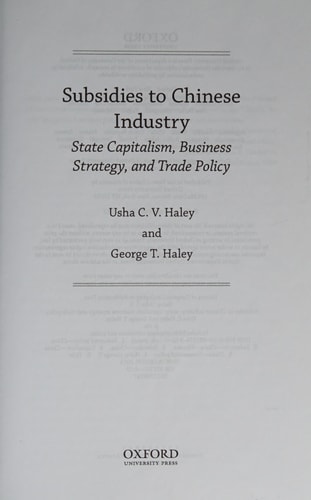
Subsidies to Chinese Industry: State Capitalism, Business Strategy, and Trade Policy
0
0
As an Amazon Associate and affiliate partner, Menrva Books earns from qualifying purchases. Learn more
Author Description
How did China move so swiftly in capital-intensive industries without labor-cost or scale advantage from bit player to the largest manufacturer and exporter in the world? This book argues that subsidies contributed significantly to China's success. Industrial subsidies in key Chinese manufacturing industries may exceed thirty percent of industrial output. Economic theories have mostly portrayed subsidies as distortive, inefficiently reallocating resources according to non-market criteria. However, China's state-capitalist regime uses subsidies to promote the governments' and the Communist Party of China's interests. Rather than aberrations, subsidies help Chinese businesses and governments produce, stabilize and create common understandings of markets; the flows of capital reflect struggles between critical Chinese actors including central and provincial governments. Concepts of state capitalism including market-transition theory, the multi-organizational Chinese state, and state as paramount shareholder, create complex and relevant understandings of Chinese subsidies. The authors develop independent measures of industrial subsidies using publicly-reported data at firm and industry levels from governmental and private sources. Subsidies include free to low-cost loans, subsidies to energy (coal, electricity, natural gas, heavy oil) and to key inputs, land and technology. Four sequential studies identify the growth of subsidies to Chinese manufacturing over time and effects on world industry: steel (2000-2007), glass (2004-2008), paper (2002-2009) and auto parts (2001-2011). Subsidies to Chinese industry affect and are affected by business strategy and trade policy. Business strategies include lobbying for subsidies and for protection from subsidized foreign competitors and managing supply chains to guard against whiplash effects of uncoordinated subsidies. The subsidized solar industry highlights how global business strategies and decisions on production location and
Menrva's Summary
THE THESIS
This book investigates how state-sponsored subsidies have functioned as a primary driver for China's rapid ascent to global manufacturing dominance. George T. Haley and Usha C. V. Haley, both experts in international business and strategy, utilize a multi-organizational framework to analyze the Chinese state-capitalist model. They argue that subsidies are not merely market distortions but are strategic tools used by the Communist Party of China to stabilize industries and achieve national objectives. By synthesizing firm-level data and government reports, the authors provide a comprehensive look at how capital flows reflect the power dynamics between central and provincial authorities.
THE SCOPE MAP
What You Will Find
- Quantitative analysis of industrial subsidies in steel, glass, paper, and auto parts sectors.
- A framework for understanding state capitalism through market-transition theory and the state as a shareholder.
- Empirical evidence derived from publicly reported firm and industry-level data.
- Examination of business strategies including lobbying, supply chain management, and global production location decisions.
THE AUTHORITY PERSPECTIVE
Experts recognize this work as a rigorous empirical examination of the mechanics behind Chinese industrial policy. Readers frequently note the technical density of the data analysis, which serves as a foundational resource for understanding the intersection of state capitalism and global trade.
Page Count:
272
Publication Date:
2013-04-25
Publisher:
Oxford University Press
ISBN-10:
0199773742
ISBN-13:
9780199773749
Economics
Business
China
International Trade
Subsidies
Industries china
Public Policy
Community Tags
Similar Books
Reader Comments
Share Your Thoughts
No comments yet. Be the first to share your thoughts!