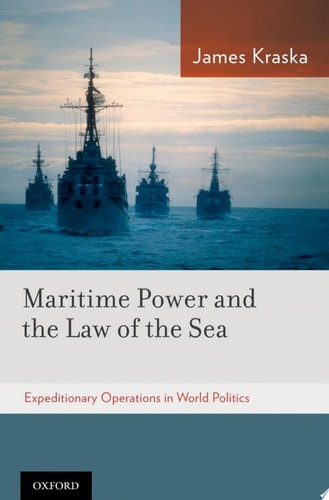
Maritime Power and the Law of the Sea: Expeditionary Operations in World Politics
0
0
As an Amazon Associate and affiliate partner, Menrva Books earns from qualifying purchases. Learn more
Author Description
In Maritime Power and the Law of the Sea: Expeditionary Operations in World Politics, Commander James Kraska analyzes the evolving rules governing freedom of the seas and their impact on expeditionary operations in the littoral, near-shore coastal zone. Coastal state practice and international law are developing in ways that restrict naval access to the littorals and associated coastal communities and inshore regions that have become the fulcrum of world geopolitics. Consequently, the ability of naval forces to project expeditionary power throughout semi-enclosed seas, exclusive economic zones (EEZs) and along the important sea-shore interface is diminishing and, as a result, limiting strategic access and freedom of action where it is most needed.Commander Kraska describes how control of the global commons, coupled with new approaches to sea power and expeditionary force projection, has given the United States and its allies the ability to assert overwhelming sea power to nearly any area of the globe. But as the law of the sea gravitates away from a classic liberal order of the oceans, naval forces are finding it more challenging to accomplish the spectrum of maritime missions in the coastal littorals, including forward presence, power projection, deterrence, humanitarian assistance and sea control. The developing legal order of the oceans fuses diplomacy, strategy and international law to directly challenge unimpeded access to coastal areas, with profound implications for American grand strategy and world politics.
Menrva's Summary
THE THESIS
How do evolving international legal frameworks regarding the law of the sea constrain the ability of naval forces to conduct expeditionary operations in littoral zones? Commander James Kraska, a legal expert and naval officer, examines the tension between traditional freedom of navigation and the increasing assertion of coastal state jurisdiction. The text synthesizes historical naval doctrine with contemporary international law to argue that the shifting legal order of the oceans directly impacts the strategic efficacy of global power projection. By analyzing the intersection of diplomacy and military access, Kraska provides a framework for understanding the future of maritime security in contested coastal regions.
THE SCOPE MAP
What You Will Find
- Analysis of the legal evolution of exclusive economic zones and territorial waters.
- Examination of the strategic challenges facing naval power projection in littoral environments.
- Case studies on the impact of international law on forward presence and sea control missions.
- Discussion of the shift from a liberal oceanic order to a more restrictive coastal state regime.
THE AUTHORITY PERSPECTIVE
Experts in maritime security and international relations identify this work as a critical resource for understanding the legal complexities of modern naval operations. Readers frequently note the technical density of the prose, which serves as a foundational text for students and practitioners of grand strategy.
Page Count:
484
Publication Date:
2011-01-19
Publisher:
Oxford University Press
ISBN-10:
0199773386
ISBN-13:
9780199773381
International Law
Maritime Strategy
Professional Career & Trade
Geopolitics
Military Science
Territorial waters
Law Of The Sea
Community Tags
Similar Books