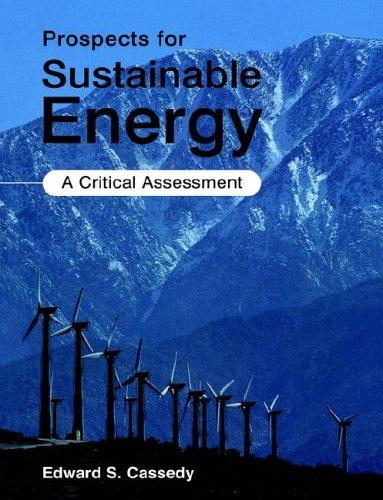
Prospects for Sustainable Energy
0
0
As an Amazon Associate and affiliate partner, Menrva Books earns from qualifying purchases. Learn more
Author Description
Prospects for Sustainable Energy explores the historical origins, technical features, marketability, and environmental impacts of the complete range of alternative sustainable energy technologies: solar, biomass, wind, hydropower, geothermal power, ocean energy sources, solar-derived hydrogen fuel, and the energy storage technologies necessary to operate them competitively. Arguments for and against implementation of each option are addressed, and the book makes a technological and economic assessment of the market readiness of these technologies and the prospects of each for reaching a competitive status. The aim of this book is to inform policy analysts and decision makers of the options available for sustainable energy production. The book is written to be accessible to an audience from a broad range of backgrounds and scientific training. It will also be a valuable supplementary text for advanced courses in environmental studies, energy economics and policy, and engineering.--Jacket.
Menrva's Summary
THE THESIS
This book investigates the viability and readiness of diverse sustainable energy technologies for widespread adoption. Edward S. Cassedy, drawing on his expertise, examines solar, biomass, wind, hydropower, geothermal, and ocean energy sources, alongside necessary storage technologies. The work critically assesses the arguments for and against each option, providing a detailed technological and economic evaluation of their market readiness and competitive potential. It is designed to inform policy analysts and decision-makers, while also serving as a supplementary text for advanced academic courses.
THE SCOPE MAP
- Historical origins and technical features of various sustainable energy technologies.
- Marketability and environmental impacts of solar, biomass, wind, hydropower, geothermal, and ocean energy.
- Analysis of energy storage technologies essential for competitive operation.
- Arguments for and against the implementation of each energy option.
- Technological and economic assessment of market readiness.
- Prospects for each technology to reach competitive status.
THE AUTHORITY PERSPECTIVE
The book is positioned as an informative resource for policy analysts and decision-makers, aiming for accessibility across a broad range of backgrounds and scientific training. Its comprehensive scope, covering historical, technical, market, and environmental aspects of numerous sustainable energy technologies, suggests it is intended as a thorough overview. The inclusion of arguments for and against each option, coupled with economic assessments, indicates a balanced approach to evaluating technological readiness. It is also noted as a valuable supplementary text for advanced courses in environmental studies, energy economics and policy, and engineering.
Page Count:
294
Publication Date:
2006-01-01
ISBN-10:
0521018374
ISBN-13:
9780521018371
Science & Technology
Economics
Non-Fiction
Energy policy
Technology Assessment
Community Tags
Similar Books