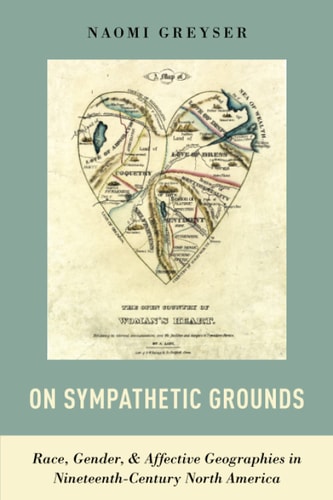
On Sympathetic Grounds
0
0
As an Amazon Associate and affiliate partner, Menrva Books earns from qualifying purchases. Learn more
Author Description
With its filigreed, formidable representations of tears and suffering, sentimentalism has remained a divisive genre and category of analysis. On Sympathetic Grounds offers a new interpretation of the sentimental by mapping its grounds in North America. During sweeping transformations of territory, land stewardship, personhood, and citizenship in the nineteenth century, sentimentalists evoked sympathy to express a desire for a place that was both territorial and emotional--what Naomi Greyser calls an "affective geography." Greyser traces the intricacies attending Americans' sentimental sense that bodies could merge and mutually occupy the same space at the same time. Affective geographies complicate normative, linear assumptions about intimacy and distance, and consequently compel a reconsideration of geopolitics, geophysics and the distribution of resources and care.Mapping feelings in and also about space, On Sympathetic Grounds focuses on the experiences and perspectives of those whose bodies, labor and sovereignty have been occupied to ground others' lives and world-making projects. Bringing literary and rhetorical studies together with critical race and gender theory, cultural geography, American studies, affect studies and the new materialism, this book lays out sentimentalism's usefulness to settler colonialism and the maintenance of racialized labor. The book also carefully charts sentimentalism's value as a means of resisting geographic displacement and both physical and metaphysical dispossession.Philosophers and rhetoricians regard grounds as necessary conditions for argumentation; Greyser treats grounds as also geopolitical, geoaffective, and geophysical. Sympathy has enriched conditions for living at the same time that it has mercilessly enlisted some bodies and lives as the grounds for others' wellbeing. Ultimately, On Sympathetic Grounds uncovers a moving, non-linear cartography of sympathy's vital place in shaping North America.
Menrva's Summary
THE THESIS
How does the sentimental genre function as a mechanism for mapping affective geographies and reinforcing settler colonial power structures in nineteenth-century North America? Naomi Greyser, a scholar in literary and cultural studies, investigates the intersection of emotion and space by analyzing sentimental literature alongside critical race, gender, and materialist theories. She argues that sentimentalism is not merely an emotional mode but a geopolitical tool that defines how bodies occupy space, distribute resources, and justify the displacement of marginalized populations. By examining the concept of "affective geography," Greyser demonstrates how sympathy has been used both to maintain racialized labor and to resist physical and metaphysical dispossession.
THE SCOPE MAP
What You Will Find
- Analysis of nineteenth-century North American literature and rhetorical texts.
- A theoretical framework connecting affect studies with cultural geography and new materialism.
- Examination of how sentimentalism facilitates settler colonialism and the occupation of bodies.
- Exploration of sympathy as a means of resisting geographic displacement.
Scope Limits
- The study focuses primarily on North American contexts and nineteenth-century developments.
- It does not provide a comprehensive history of the sentimental genre outside of its geopolitical and affective functions.
THE AUTHORITY PERSPECTIVE
Scholars in American studies and literary theory recognize this work as a rigorous interdisciplinary intervention that challenges traditional understandings of sentimentalism. Readers frequently note the academic density of the prose and the complexity of the theoretical synthesis provided by the author.
Page Count:
274
Publication Date:
2020-02-06
Publisher:
Oxford University Press
ISBN-10:
0190087625
ISBN-13:
9780190087623
History
Sociology
Affect Theory
Literary Criticism
American Studies
Community Tags
Other Editions(2)
Similar Books







Reader Comments
Share Your Thoughts
No comments yet. Be the first to share your thoughts!