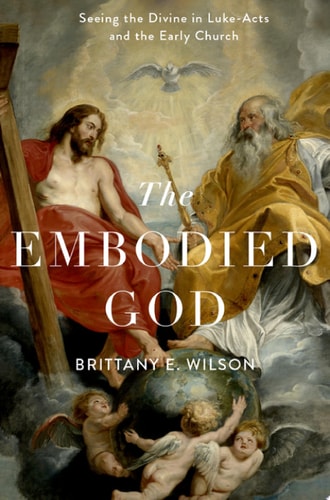
The Embodied God: Seeing the Divine in Luke-Acts and the Early Church
0
0
As an Amazon Associate and affiliate partner, Menrva Books earns from qualifying purchases. Learn more
Author Description
As inheritors of Platonic traditions, many Jews and Christians today do not believe that God has a body. God is instead invisible and incorporeal, and even though Christians believe that God can be seen in Jesus, God otherwise remains veiled from human sight. In this ground-breaking work, Brittany E. Wilson challenges this prevalent view by arguing that early Jews and Christians often envisioned God as having a visible form. Within the New Testament, Luke-Acts in particular emerges as an important example of a text that portrays God in visually tangible ways. According to Luke, God is a perceptible, concrete being who can take on a variety of different forms, as well as a being who is intimately intertwined with human fleshliness in the form of Jesus. In this way, the God of Israel does not adhere to the incorporeal deity of Platonic philosophy, especially as read through post-Enlightenment eyes. Given the corporeal connections between God and Jesus, Luke's depiction of Jesus's body also points ahead to future controversies concerning his divinity and humanity in the early church. Indeed, questions concerning God's body are inextricably linked with Christology and shed light on how we are to understand Jesus's own visible embodiment in relation to God.In The Embodied God, Wilson reframes approaches to early Christology within New Testament scholarship and calls for a new way of thinking about divine-and human-bodies and embodied experience.
Menrva's Summary
THE THESIS
Does the portrayal of God in Luke-Acts challenge the traditional theological assumption that the divine is strictly incorporeal? Brittany E. Wilson, a scholar of New Testament studies, examines early Jewish and Christian texts to argue that God was frequently envisioned as having a visible, tangible form. By analyzing the narrative of Luke-Acts, Wilson demonstrates that the text presents a God who interacts with the physical world and is intimately connected to the human flesh of Jesus, thereby contesting the influence of Platonic philosophy on modern theological interpretations.
THE SCOPE MAP
What You Will Find
- Analysis of divine visibility within the New Testament, specifically focusing on Luke-Acts.
- A critique of post-Enlightenment and Platonic interpretations of divine incorporeality.
- Examination of the theological link between God's body and the Christological debates of the early church.
Scope Limits
- The study does not provide an exhaustive history of all early Christian views on the body.
- The analysis is primarily restricted to the Lukan corpus rather than a comprehensive survey of the entire New Testament canon.
THE AUTHORITY PERSPECTIVE
Scholars in the field of biblical studies recognize this work as a significant contribution to the ongoing discourse regarding Lukan theology and early Christology. Readers frequently note the academic density of the prose, which is intended for an audience familiar with theological scholarship and historical-critical methods.
Page Count:
349
Publication Date:
2021-01-01
Publisher:
Oxford University Press
ISBN-10:
0190080841
ISBN-13:
9780190080846
Religion
Judaism
Bible
Christology
Bibles
Incarnation
Christian Theology
Community Tags
Similar Books