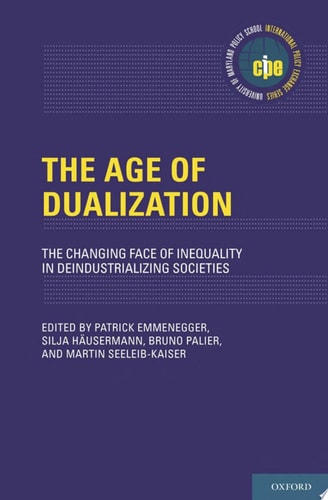
The Age of Dualization: The Changing Face of Inequality in Deindustrializing Societies
0
0
As an Amazon Associate and affiliate partner, Menrva Books earns from qualifying purchases. Learn more
Author Description
Poverty, increased inequality, and social exclusion are back on the political agenda, not only as a consequence of the Great Recession of 2008, but also because of a seemingly structural trend towards increased inequality in advanced industrial societies that has persisted since the 1970s. Policies in labor markets, social policy, and political representation are strongly linked in the creation, widening, and deepening of insider-outsider divides--a process known as dualization. While it is certainly not the only driver of increasing inequality, its development across multiple domains makes dualization one of the most important current trends affecting developed societies.The comparative perspective of this book provides insights into why Nordic countries witness lower levels of insider-outsider divides, whereas in continental, liberal and southern welfare states, they are more likely to constitute a core characteristic of the political economy. Most importantly, the comparisons presented in this book point to the crucial importance of politics and political choice in driving and shaping the social outcomes of deindustrialization. While increased structural labor market divides can be found across all countries, governments have a strong responsibility in shaping the distributive consequences of these labor market changes. Insider-outsider divides are ultimately the result of political choice.A landmark publication, this volume is geared for faculty and graduate students of economics, political science, social policy, and sociology, as well as policymakers concerned with increasing inequality in a period of deep economic and social crisis.
Menrva's Summary
THE THESIS
This book investigates the structural drivers of inequality in deindustrializing societies by examining the process of dualization and the creation of insider-outsider divides in labor markets. The authors, a team of scholars specializing in political economy and social policy, utilize comparative analysis across various welfare state models to argue that these divides are not merely inevitable economic outcomes but are significantly shaped by political choices and policy frameworks. By analyzing labor market regulations and social protection systems, the text provides a comprehensive look at how governments influence distributive consequences during periods of economic transition.
THE SCOPE MAP
What You Will Find
- Comparative analysis of welfare state models including Nordic, continental, liberal, and southern systems.
- Examination of the intersection between labor market policy, social policy, and political representation.
- Empirical evidence regarding the persistence of inequality trends since the 1970s.
- Theoretical framework for understanding the mechanisms of insider-outsider divides in deindustrializing economies.
THE AUTHORITY PERSPECTIVE
Experts identify this volume as a significant contribution to the study of comparative political economy and social stratification. Readers frequently note the academic density of the prose, making it a primary resource for graduate-level research and policy analysis.
Page Count:
352
Publication Date:
2012-01-17
Publisher:
Oxford University Press
ISBN-10:
0199797897
ISBN-13:
9780199797899
Economics
Social policy
Labor Studies
Sociology
Labor Market
Social Classes
Community Tags
Similar Books