Love, Mystery, and Misery
0
0
As an Amazon Associate and affiliate partner, Menrva Books earns from qualifying purchases. Learn more
Author Description
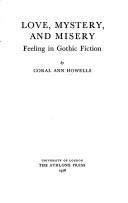
The current Gothic revival in literature and film encourages us to look again to the earliest Gothic novels written between 1790 and 1820, when Gothic was the most popular kind of fiction in England. Dr. Howells proposes a radical reassessment of these novels to emphasize their importance as experiments in imaginative writing. Her object, the study of feeling, is central to Gothic, for its spell consists in the feelings it arouses and exercises. As pseudo-historical fantasy, Gothic fiction embodies contemporary neuroses, especially sexual fears and repressions, which run right through it and are basic to its conventions. This study traces the effort to articulate these disconcerting emotions in symbol, incident, landscape and architecture. The chronological design suggests developments in Gothic, from the initial explorations of Mrs Radcliffe and M.G. Lewis, through the Minerva Press novelists and Jane Austen's'quot; Northanger Abbey'quot;, to new directions taken by C.R. Maturin in 'Melmoth the Wanderer' and later by Charlotte Brontë whose 'Jane Eyre,' arguably the finest of Gothic novels, places the earlier experiments in perspective.
Menrva's Summary
THE THESIS
This book offers a radical reassessment of early Gothic novels, emphasizing their experimental nature and their exploration of contemporary neuroses, particularly sexual fears and repressions. Coral Ann Howells, a recognized scholar in the field, examines the period between 1790 and 1820, when Gothic fiction was at its peak popularity in England. The study traces how authors like Ann Radcliffe, M.G. Lewis, Jane Austen, C.R. Maturin, and Charlotte Brontë used symbolism, incident, landscape, and architecture to articulate unsettling emotions. Howells argues that the enduring spell of Gothic literature lies in the feelings it evokes and explores, making it a crucial lens through which to understand the psychological landscape of its time.
THE SCOPE MAP
- Analysis of the current Gothic revival in literature and film.
- Focus on early Gothic novels written between 1790 and 1820.
- Emphasis on the importance of Gothic novels as experiments in imaginative writing.
- Exploration of the study of feeling as central to the Gothic genre.
- Examination of Gothic fiction as embodying contemporary neuroses, especially sexual fears and repressions.
- Tracing the articulation of these emotions through symbol, incident, landscape, and architecture.
- Chronological design tracing developments from Mrs. Radcliffe and M.G. Lewis to Jane Austen, C.R. Maturin, and Charlotte Brontë.
THE AUTHORITY PERSPECTIVE
This scholarly work is recognized for its insightful analysis of the early Gothic novel, positioning it as a significant experimental genre. Dr. Howells's approach offers a fresh perspective, moving beyond traditional interpretations to highlight the psychological depth and thematic relevance of these foundational texts. The book is noted for its comprehensive scope, covering key authors and their contributions to the development of Gothic literature. Its arguments regarding the exploration of sexual fears and repressions within the genre provide a compelling framework for understanding its enduring appeal.
Page Count:
199
Publication Date:
1978-01-01
ISBN-10:
0485111810
ISBN-13:
9780485111811
History
Mystery
Horror
Non-Fiction
Fiction
Literary Criticism
Literary History
Gothic
Community Tags
Similar Books