Educational Research
0
0
As an Amazon Associate and affiliate partner, Menrva Books earns from qualifying purchases. Learn more
Author Description
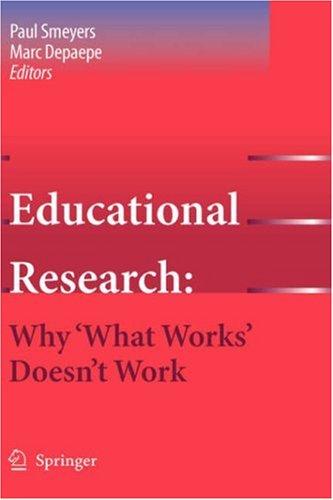
Education and educational research, according to the current fashion, are supposed to be concerned with ‘what works’, to the exclusion of all other considerations. All over the world, and particularly in the English-speaking countries, governments look for means of improving ‘student achievement’ as measured by standardized test scores. Although such improvements are often to be welcomed, they do not answer all significant questions about what constitutes good education. Also the research on which they are based is not the only legitimate way to do educational research. Social research, and therefore educational research, cannot ignore the distinctive nature of what it studies: a social activity where questions of meaning and value cannot be eliminated, and where interpretation and judgment play a crucial role. In this book distinguished philosophers and historians of education from 6 countries focus on the problematical nature of the search for ‘what works’ in educational contexts, in practice as well as in theory. Beginning with specific problems, they move on to more general and theoretical considerations, seeking to go beyond over-simple ideas about cause and effect and the rhetoric of performativity that currently has educational thinking in its grip. ‘Freedom of inquiry in educational research can no longer be taken for granted. Narrow definitions of what constitutes ‘scientific’ research, funding criteria that enforce particular research methods, and policy decision processes that ignore any research that is not narrowly utilitarian, create a context in many countries that discourages scholarship of a more speculative, exploratory, or critical sort. This book brings together an exceptional combination of international and cross-disciplinary scholars who bring the perspectives of history and philosophy of science to ask, ‘How did we arrive at this place? and ‘Where is educational research heading? The book illuminates the anti-intellectual consequences of a
Menrva's Summary
THE THESIS
This book challenges the prevailing notion that educational research should solely focus on identifying 'what works,' particularly as measured by standardized test scores. It argues that such a narrow focus neglects crucial questions of meaning, value, interpretation, and judgment inherent in education as a social activity. The book brings together international scholars to critically examine the current state and future direction of educational research, pushing beyond simplistic cause-and-effect models and the rhetoric of performativity that dominates educational thinking.
THE SCOPE MAP
- Critique of the 'what works' paradigm in educational research.
- Exploration of the philosophical and historical underpinnings of educational inquiry.
- Analysis of the impact of narrow definitions of 'scientific' research on academic freedom.
- Discussion of funding criteria and policy decisions that favor utilitarian research methods.
- Examination of the anti-intellectual consequences of current research trends.
- Contributions from distinguished philosophers and historians of education across six countries.
- Focus on the problematical nature of educational research in practice and theory.
- Consideration of questions of meaning, value, interpretation, and judgment in education.
THE AUTHORITY PERSPECTIVE
This collection of essays critically examines the dominant trends in contemporary educational research, particularly the emphasis on quantifiable outcomes and the 'what works' approach. The contributors, drawing on philosophical and historical perspectives, question the narrow utilitarianism that often dictates research funding and policy. The book aims to stimulate a broader, more critical, and theoretically informed discussion about the nature and future of educational inquiry, highlighting the potential for anti-intellectualism when research is overly constrained by performativity metrics.
Page Count:
194
Publication Date:
2012-01-01
ISBN-10:
9400750390
ISBN-13:
9789400750395
Philosophy
History
Psychology
Non-Fiction
Education
Community Tags
Similar Books