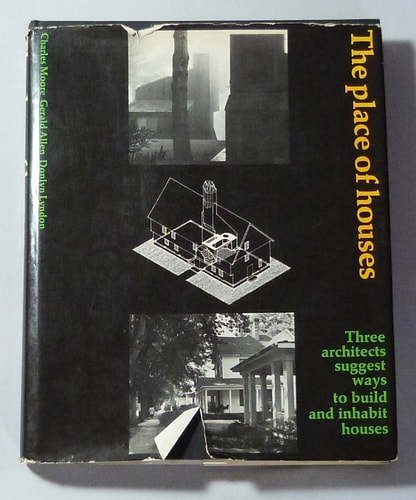
The place of houses
0
0
As an Amazon Associate and affiliate partner, Menrva Books earns from qualifying purchases. Learn more
Author Description
With a new epilogueRichly illustrated with houses large and small, old and new, with photographs, plans, and cutaway drawings, this is a book for people who want a house but who may not know what they really need, or what they have a right to expect.The authors establish the basis for good building by examining houses in the small Massachusetts town of Edgartown; in Santa Barbara, California, where a commitment was made to re-create an imaginary Spanish past; and in Sea Ranch, on the northern California coast, where the authors attempt to create a community. These examples demonstrate how individual houses can express the care, energies, and dreams of the people who live in them, and can contribute to a larger sense of place.
Menrva's Summary
THE THESIS
This work investigates the fundamental relationship between residential architecture, personal identity, and the creation of a meaningful sense of place. The authors, all distinguished architects and educators, utilize a combination of historical analysis and contemporary case studies to argue that a house should be more than a shelter; it should be a physical manifestation of the inhabitants' values and aspirations. By examining diverse regional examples, they provide a framework for understanding how architectural design can balance individual needs with the broader context of a community.
THE SCOPE MAP
What You Will Find
- Comparative analysis of residential architecture in Edgartown, Santa Barbara, and Sea Ranch.
- Extensive use of architectural plans, cutaway drawings, and site photography.
- Methodologies for identifying personal housing needs and expectations.
- Exploration of the intersection between regional history and modern building practices.
Scope Limits
- The text does not provide technical construction manuals or engineering specifications.
- It does not cover high-density urban apartment living or commercial architecture.
THE AUTHORITY PERSPECTIVE
Architectural historians and practitioners frequently cite this work as a foundational text for understanding the humanistic side of residential design. Readers often note that the prose remains accessible to non-experts while offering enough depth to satisfy professional architects interested in the philosophy of place-making.
Page Count:
278
Publication Date:
1974-01-01
Publisher:
Holt, Rinehart and Winston
ISBN-10:
0030077265
ISBN-13:
9780030077265
Architecture
Residential Architecture
Buildings
Architecture
urban planning
Design
Housing
Community Tags
Similar Books