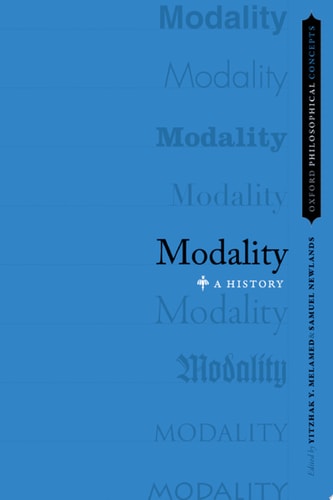
Modality: A History
0
0
As an Amazon Associate and affiliate partner, Menrva Books earns from qualifying purchases. Learn more
Author Description
Modality: A History provides readers a sweeping study of the history of philosophical work on modal concepts. Everyday discourse is saturated with appeals to what might be the case or to what must be true or to what cannot happen. Possibility, necessity, and impossibility are modal terms, and philosophers have long wondered how to best understand them. This volume traces the history of some of the most prominent and important contributions to our understanding of possibility and necessity over the past two and half millennia of western philosophy, from ancient Greek philosophers through current debates in the 21st century.Over the course of nine chapters from prominent scholars, this volume traces a history of modal theorizing that begins with extended discussions of Aristotle and the Stoics. Several chapters discuss insights and disagreements among Latin, Arabic, and Jewish medieval scholastics, such as Al-Ghazâlî, Scotus, and Crescas. Three chapters center on early modern philosophers, whose modal views were deeply shaped by this conceptual inheritance but also departed from it in significant ways: Descartes, Malebranche, Locke, Spinoza, Leibniz, and Hume. Kant and Hegel's modal contributions are presented in their own chapter, and another chapter traces the legacy of Kant's account on early-to-mid 20th century modal views, including Husserl, Heidegger, Russell, and Quine.The revival of modal metaphysics in the more recent work of Kripke, Marcus, and Lewis has led to a new flourishing of modal theories, including in recent debates among neo-Aristotelians, as the final chapter illustrates. Although modal concepts are interesting and important on their own, theories of modality often intersect with other significant philosophical topics, such as time, freedom, and God. Modal concepts also extend beyond metaphysics. To illustrate the role of modality in other domains, several small-scale studies, or Reflections, are dispersed among these main chapters on modality in cosmology, religion, music, literature, and logic. Readers will learn how a seemingly timeless and changeless cluster of modal concepts have undergone significant revisions and enjoy a rich developmental history.
Menrva's Summary
THE THESIS
This volume investigates the evolution of modal concepts—specifically necessity, possibility, and impossibility—across two and a half millennia of Western philosophical thought. Edited by Samuel Newlands and Yitzhak Y. Melamed, the work compiles contributions from prominent scholars to map how these concepts have been defined, debated, and transformed from antiquity to the 21st century. The text provides a structured framework for understanding the intersection of modality with broader metaphysical topics such as time, freedom, and theology.
THE SCOPE MAP
What You Will Find
- Historical analysis of modal theories from Aristotle and the Stoics through medieval scholasticism.
- Examination of early modern shifts in modal thought involving Descartes, Spinoza, Leibniz, and Hume.
- Exploration of 20th-century developments including the work of Kripke, Marcus, and Lewis.
- Integrated 'Reflections' that demonstrate the application of modal concepts in non-metaphysical domains.
Scope Limits
- The text focuses primarily on the Western philosophical tradition and does not provide an exhaustive global history of modal logic.
- The volume prioritizes historical and conceptual development over the technical formalization of modern modal logic systems.
THE AUTHORITY PERSPECTIVE
Scholars and students of philosophy identify this volume as a comprehensive resource for tracing the conceptual lineage of modal theory. Readers frequently note the academic density of the prose, which serves as a rigorous reference for those already familiar with the history of metaphysics.
Page Count:
360
Publication Date:
2024-01-01
Publisher:
Oxford University Press
ISBN-10:
0190089857
ISBN-13:
9780190089856
Politics
Philosophy
History & Schools of Thought
Logic
Metaphysics
Academic
Philosophy history
Community Tags
Similar Books

Reader Comments
Share Your Thoughts
No comments yet. Be the first to share your thoughts!