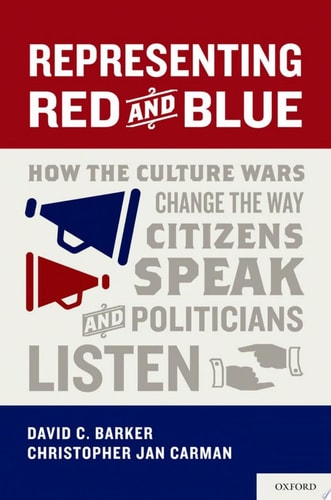
Representing Red and Blue: How the Culture Wars Change the Way Citizens Speak and Politicians Listen
0
0
As an Amazon Associate and affiliate partner, Menrva Books earns from qualifying purchases. Learn more
Author Description
What is a political representative's job, really? Are they supposed to simply figure out what "the people" want and deliver it, or are they charged to do what they think is best for their constituents -- even if that means sometimes ignoring those constituents' wishes? In Representing Red and Blue, David Barker and Christopher Carman explore what people think about this question, why their answers vary, and what difference it makes. They observe that the citizens of "Red America" -- religious and cultural traditionalists, including most Republicans -- often prefer lawmakers who challenge public opinion, whereas "Blue Americans," or culturally progressive Democrats, typically prefer lawmakers who follow it. What is more, these preferences filter up: lawmakers who represent progressive locales tend to pursue the policies their constituents want, whereas representatives of more traditionalistic places often behave quite differently, leaning decidedly to the Right of even most Red American voters. The fundamental reason underlying these patterns, Barker and Carman argue, is that on average, traditionalists and progressives simply do not hold the values of liberal popular democracy in equally high esteem. What all of this means is that the citizens of Red America live in a different kind of democracy than that of the citizens of Blue America -- one where they have less political say over what their government does, but one that seems to suit their tastes all the same.
Menrva's Summary
THE THESIS
This book investigates how divergent cultural values between traditionalist and progressive citizens fundamentally alter the expectations and behaviors of political representation in the United States. Authors Christopher Jan Carman and David C. Barker utilize extensive survey data and political analysis to argue that "Red" and "Blue" Americans hold conflicting views on the role of a representative. They posit that these cultural differences create two distinct democratic experiences, where the value placed on popular sovereignty varies significantly based on ideological alignment.
THE SCOPE MAP
What You Will Find
- Analysis of voter expectations regarding delegate versus trustee models of representation.
- Comparative study of political behavior in culturally traditionalist versus progressive districts.
- Quantitative data derived from public opinion surveys and legislative voting records.
- Examination of how cultural values influence the perceived legitimacy of government actions.
THE AUTHORITY PERSPECTIVE
Experts in political science recognize this work as a significant contribution to the study of how cultural identity shapes democratic institutions. Readers frequently note the academic density of the prose, which provides a rigorous framework for understanding the current polarization in American legislative behavior.
Page Count:
208
Publication Date:
2012-09-18
Publisher:
Oxford University Press
ISBN-10:
0199796564
ISBN-13:
9780199796564
Social choice
Politics And Culture
Representative government and representation
Sociology
Democracy
Voting
Political Psychology
United States
American Politics
Community Tags
Similar Books