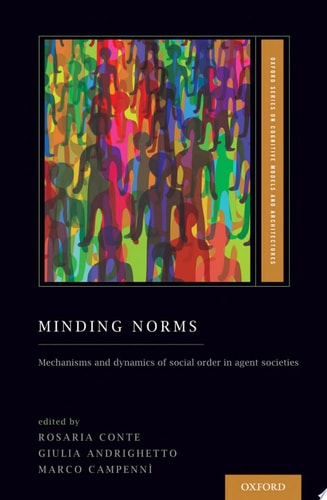
Minding Norms: Mechanisms and Dynamics of Social Order in Agent Societies
0
0
As an Amazon Associate and affiliate partner, Menrva Books earns from qualifying purchases. Learn more
Author Description
Norms are prescribed conducts applied by the majority of people. Getting across cultures and centuries, norms evolved to rule all human relationships, from the most formal to the most intimate. Impinging on any sphere of life, from religious to political, norms affect social, moral, and even aesthetical behaviours. They are enforced through centralized sanctions or distributed control, and originate through deliberate acts of issuing or from spontaneous interaction in informal settings. Despite ubiquity and universality, norms are still awaiting for a general comprehensive theory, simultaneously doing justice to three intuitions: that, under variable contents, norms correspond to a common notion; that, once brought about, norms feedback on their producers, affecting their conducts; and finally that before and in order to drive the behaviours of individuals, norms must affect their beliefs and goals: people must detect and accept norms before converting them into observable behaviours.This volume presents an unprecedented attempt to account for all the three intuitions at once, providing a systematic view of norms. Based on a unitary and operational notion of norms, as behaviours spreading thanks to and to the extent that the corresponding prescriptions spread as well, a cognitive architecture, EMIL-A, which is the main output of a research project on norm emergence, is described. EMIL-A is a BDI-like platform for simulation, endowed with modules for detecting, reasoning and deciding upon norms. Next, the EMIL-A platform is applied to generate norms in different simulated scenarios (from a multi-setting world to a virtual Wikipedia), through a complex bidirectional dynamics, i.e., the bottom-up emergence of norms thanks to a gradual, top-down process, denoted as immergence. As simulations results show, norms emerge while immerging in agents' minds, thanks to their detecting, reasoning, and deciding whether to respect them or not.
Menrva's Summary
THE THESIS
This volume investigates the mechanisms by which social norms emerge, persist, and influence individual behavior within agent-based societies. The authors, Giulia Andrighetto, Marco Campennì, and Rosaria Conte, leverage their expertise in cognitive modeling and social simulation to propose a unified theory of normativity. By integrating psychological insights with computational architecture, they argue that norms function as feedback loops that require agents to detect, process, and internalize prescriptions before they manifest as observable social conduct.
THE SCOPE MAP
What You Will Find
- A comprehensive cognitive architecture model known as EMIL-A designed for norm simulation.
- Analysis of the bidirectional dynamics between bottom-up norm emergence and top-down immergence.
- Case studies applying the EMIL-A platform to diverse environments, including virtual Wikipedia settings.
- A systematic framework for understanding how beliefs and goals mediate the adoption of social rules.
THE AUTHORITY PERSPECTIVE
Experts recognize this work as a significant contribution to the field of multi-agent systems and social simulation. Readers frequently note the technical density of the prose, which is best suited for researchers and students familiar with cognitive modeling and computational sociology.
Page Count:
188
Publication Date:
2013-10-25
Publisher:
Oxford University Press
ISBN-10:
0199812675
ISBN-13:
9780199812677
Computer Science
Sociology
Simulation
Social Norms
Community Tags
Similar Books









Reader Comments
Share Your Thoughts
No comments yet. Be the first to share your thoughts!