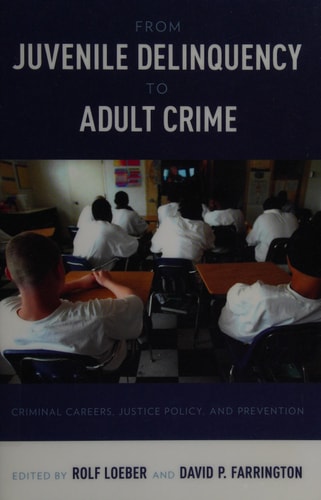
From Juvenile Delinquency to Adult Crime: Criminal Careers, Justice Policy, and Prevention
0
0
As an Amazon Associate and affiliate partner, Menrva Books earns from qualifying purchases. Learn more
Author Description
What makes a juvenile delinquent develop into an adult criminal? What defines-cognitively, developmentally, legally-the transition from juvenile to adult and what determines whether patterns of criminal behavior persist? In most US states and Western nations, legal adulthood begins at age 18. This volume focuses on the period surrounding that abrupt transition (roughly ages 15-29) and addresses what happens to offending careers during it.Edited by two leading authorities in the fields of psychology and criminology, Transitions from Juvenile Delinquency to Adult Crime examines why the period of transition is important and how it can be better understood and addressed both inside and outside of the justice system. Bringing together over thirty leading scholars from multiple disciplines in both North America and Europe, this volume asks critical questions about criminal careers and causation, and whether current legal definitions of adulthood accurately reflect actual maturation and development. The volume also addresses the current efficacy of the justice system in addressing juvenile crime and recidivism, why and how juveniles ought to be treated differently from adults, if special legal provisions should be established for young adults, and the effectiveness of crime prevention programs implemented during early childhood and adolescence.With serious scholarly analysis and practical policy proposals, Transitions from Juvenile Delinquency to Adult Crime addresses what can be done to ensure that today's juvenile delinquents do not become tomorrow's adult criminals.
Menrva's Summary
THE THESIS
This volume investigates the developmental and legal factors that influence the transition from juvenile delinquency to persistent adult criminal behavior. Edited by David P. Farrington and Rolf Loeber, the text synthesizes research from over thirty scholars across North America and Europe. It evaluates the efficacy of current justice systems, the accuracy of legal definitions regarding adulthood, and the impact of early intervention programs on long-term recidivism rates.
THE SCOPE MAP
What You Will Find
- Longitudinal analysis of criminal careers between the ages of 15 and 29.
- Comparative study of legal frameworks and age-of-adulthood definitions across Western nations.
- Evaluation of crime prevention strategies implemented during childhood and adolescence.
- Interdisciplinary research integrating developmental psychology and criminal justice policy.
THE AUTHORITY PERSPECTIVE
Experts recognize this volume as a comprehensive resource for policymakers and academics studying the intersection of developmental biology and criminal law. Readers frequently note the academic density of the prose and the rigor of the multi-disciplinary evidence presented.
Page Count:
416
Publication Date:
2012-06-06
Publisher:
Oxford University Press
ISBN-10:
0199828180
ISBN-13:
9780199828180
Psychology
Criminal Behavior Prediction Of
Law
Sociology
Social Science
Administration of Justice
Public Policy
Criminology
Community Tags
Similar Books