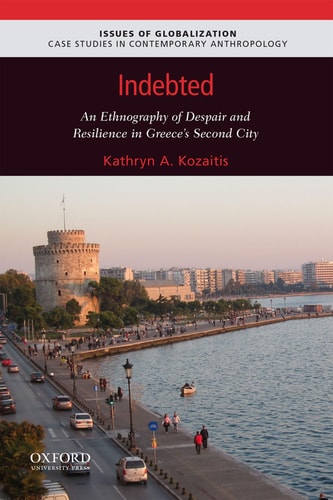
Indebted: An Ethnography of Despair and Resilience in Greece's Second City
0
0
As an Amazon Associate and affiliate partner, Menrva Books earns from qualifying purchases. Learn more
Author Description
This engagingly written and deeply ethnographic work examines the economic and political factors that led to the Greek debt crisis, including financial pressures from international lenders, unregulated spending by the Greek government, predatory bank loans, and rising unemployment.Indebted looks closely at the cultural dimensions of the crisis: how middle class urbanites experienced the shock of a global fiscal collapse, managed societal instability, and worked to sustain their families in the face of structural pressures, local instabilities, and moral imperatives. Author Kathryn A. Kozaitis based her analysis on ethnographic research in Thessaloniki, the second largest city and co-capital of Greece, during the summer of 2009, 2011-2012, and ethnographic updates in 2013-2019. She places particular emphasis on the lived experience of Thessalonikians in what emerged as a culture of crisis--collective, patterned behaviors, thoughts, and emotions characteristic of a people in sociocultural transformation--in an uncertain present marked by past realities and future imaginaries. The book synthesizes hundreds of crisis narratives, depicting Thessalonikians' responses to their country's political disaster and downward mobility through the themes of loss and displacement; blame and accountability; reconfigurations of kinship roles and responsibilities; emotional and intellectual awakenings; and emergent indicators of survival, continuity, and renewal through alternative praxis.Indebted is a volume in the series ISSUES OF GLOBALIZATION: CASE STUDIES IN CONTEMPORARY ANTHROPOLOGY, which examines the experiences of individual communities in our contemporary world. Each volume offers a brief and engaging exploration of a particular issue arising from globalization and its cultural, political, and economic effects on certain peoples or groups.
Menrva's Summary
THE THESIS
How did the Greek debt crisis fundamentally alter the social fabric and daily survival strategies of urban middle-class citizens in Thessaloniki? Kathryn A. Kozaitis, an anthropologist, utilizes extensive ethnographic fieldwork conducted between 2009 and 2019 to analyze the intersection of macro-economic collapse and individual lived experience. She argues that the crisis fostered a distinct 'culture of crisis,' characterized by specific behavioral and emotional patterns as citizens navigated downward mobility and structural instability.
THE SCOPE MAP
What You Will Find
- Longitudinal ethnographic data from Thessaloniki, Greece, spanning 2009 to 2019.
- Analysis of the 'culture of crisis' framework regarding societal transformation.
- Qualitative synthesis of hundreds of personal crisis narratives.
Scope Limits
- The study focuses primarily on the urban middle class in Thessaloniki rather than rural populations or political elites.
- It does not provide a comprehensive technical audit of Greek national financial policy.
THE AUTHORITY PERSPECTIVE
Scholars and anthropologists recognize this work as a significant contribution to the study of globalization's localized impacts on European societies. Readers frequently note the accessible yet rigorous nature of the ethnographic prose, which effectively bridges the gap between economic theory and human experience.
Page Count:
256
Publication Date:
2020-01-24
Publisher:
Oxford University Press
ISBN-10:
0190090146
ISBN-13:
9780190090142
Economics
Greece
Anthropology
Globalization
Sociology
Community Tags
Other Editions(2)

Similar Books







Reader Comments
Share Your Thoughts
No comments yet. Be the first to share your thoughts!