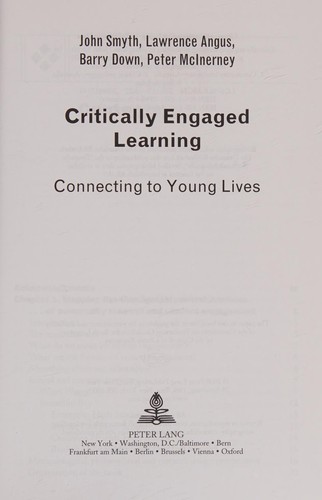
Critically Engaged Learning
0
0
As an Amazon Associate and affiliate partner, Menrva Books earns from qualifying purchases. Learn more
Author Description
"This book - the finale in a trilogy by the authors - traces the way in which a number of disadvantaged schools and communities were able to move beyond deficit, victim-blaming and pathologizing approaches and access resources of trust, relationships, connectedness and hope. It describes how these Australian schools and communities were able to benefit from working with 'street-level' bureaucrats who had reinvented themselves around notions of socially just forms of capacity-building. The book provides a set of insights into what is possible from a critical engagement for school and community renewal perspective, by working with the resources that exist within disadvantaged contexts, even in damaging neoliberal policy times."--Jacket.
Menrva's Summary
THE THESIS
This book investigates how disadvantaged schools and communities can overcome deficit-based approaches through relational and hopeful capacity-building. The finale in a trilogy, it details the transformation of Australian schools and communities by engaging 'street-level' bureaucrats who embraced socially just methods. It offers insights into achieving renewal by leveraging existing resources within disadvantaged contexts, even amidst challenging neoliberal policies.
THE SCOPE MAP
- Case studies of disadvantaged schools and communities in Australia.
- Analysis of 'street-level' bureaucrats and their role in capacity-building.
- Exploration of trust, relationships, and connectedness as resources for renewal.
- Critique of deficit, victim-blaming, and pathologizing approaches in education and community work.
- Strategies for socially just capacity-building within existing community resources.
- Examination of the impact of neoliberal policies on disadvantaged contexts.
THE AUTHORITY PERSPECTIVE
This work is positioned as a critical examination of educational and community renewal strategies, likely appealing to academics, policymakers, and practitioners in social justice and education. The book's focus on practical application within disadvantaged contexts suggests it offers actionable insights for those working in similar fields. Its placement as the finale of a trilogy indicates a developed theoretical framework and a sustained engagement with the subject matter.
Page Count:
205
Publication Date:
2008-01-01
ISBN-10:
1433101556
ISBN-13:
9781433101557
Non-Fiction
Community Development
Education
Sociology
Social justice