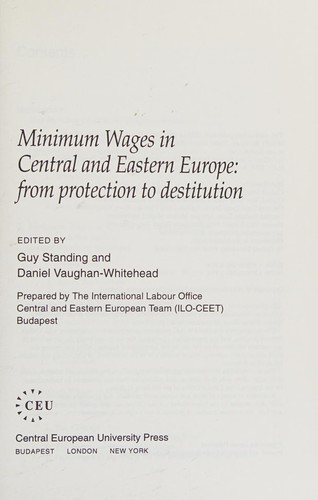
Minimum Wages in Central and Eastern Europe
0
0
As an Amazon Associate and affiliate partner, Menrva Books earns from qualifying purchases. Learn more
Author Description
Since the Late 1980s incomes have fallen sharply in most countries of Central and Eastern Europe, with unemployment and poverty rates rising dramatically. The ILO's Central and Eastern European Team has conducted a series of studies concerning the role of minimum wages in the countries of this rapidly transforming region, in particular looking at ways in which this role should be revised. Based on this research, Minimum Wages in Central and Eastern Europe examines the most crucial issues in Bulgaria, the Czech Republic, Hungary, Moldavia, Poland, Romania and Russia, and compares their systems with those of western industrialized economies. Bringing together primary data so far unknown beyond a small circle of policymakers and officials, the contributors consider the evidence and the implications of new developments and recommend a series of reforms.
Menrva's Summary
THE THESIS
This book investigates the evolving role and impact of minimum wages in Central and Eastern European countries following significant economic shifts. Guy Standing, drawing on research from the ILO's Central and Eastern European Team, examines the critical issues surrounding minimum wages in Bulgaria, the Czech Republic, Hungary, Moldavia, Poland, Romania, and Russia. The work compares these systems to those in Western industrialized economies, utilizing primary data previously accessible only to a select group of policymakers. It concludes by recommending a series of reforms based on the evidence presented.
THE SCOPE MAP
- Analysis of minimum wage systems in Bulgaria, Czech Republic, Hungary, Moldavia, Poland, Romania, and Russia.
- Comparative study of Central and Eastern European minimum wage policies against those of Western industrialized economies.
- Inclusion of primary data previously unavailable outside of policy circles.
- Examination of the impact of minimum wages on rising unemployment and poverty rates.
- Consideration of new developments and their implications for wage policy.
- Recommendations for reforms to minimum wage structures in the region.
THE AUTHORITY PERSPECTIVE
This book presents a detailed analysis of minimum wage policies in post-communist Central and Eastern Europe, drawing on specific country case studies and primary data. The research aims to inform policymakers about the effectiveness and potential reforms of minimum wage systems in a rapidly transforming economic landscape. The comparative approach, contrasting the region with Western economies, provides a broader context for understanding the challenges and opportunities. The work is positioned as a resource for those involved in economic policy and labor market regulation in these countries.
Page Count:
144
Publication Date:
1995-01-01
ISBN-10:
1858660432
Economics
Non-Fiction
Eastern Europe
Community Tags
Similar Books