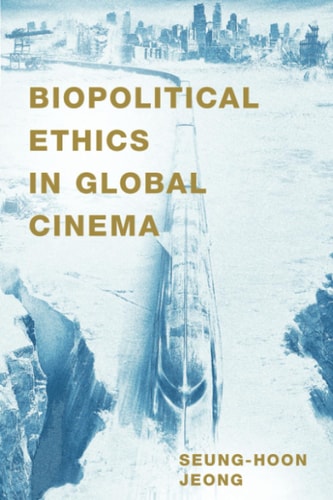
Biopolitical Ethics in Global Cinema
0
0
As an Amazon Associate and affiliate partner, Menrva Books earns from qualifying purchases. Learn more
Author Description
Biopolitical Ethics in Global Cinema takes a new approach to world cinema through critical theory. Whereas world cinema often refers to non-American films deemed artistic or peripheral, Seung-hoon Jong examines its mapping frames: the territorial 'national frame,' the deterritorializing 'transnational frame,' and the 'global frame.' If world cinema studies have mostly displayed national cinemas and their transnational mutations, his global frame highlights two conflicting ethical facets of globalization: the 'soft-ethical' inclusion of differences in multicultural, neoliberal systems and their 'hard-ethical' symptoms of fundamentalist exclusion and terror. Reflecting both and suggesting their alternatives, global cinema draws attention to new changes in subjectivity and community that Jeong investigates in terms of biopolitical 'abjection' and ethical 'agency.'In this frame, the book explores a vast net of post-1990 films circulating in both the mainstream market and the festival circuit. Jeong comparatively navigates these films, highlighting less essentialist particularities than compatible localities that perform universal aspects of biopolitical ethics and its alternatives by centering the narrative of 'double death': the abject as symbolically dead struggle for lost subjectivity or new agency until physically dying. This narrative pervades global cinema from Hollywood blockbusters and European art films to Middle Eastern dramas and Asian genre films. Ultimately, the book renews critical discourses on global issues―including multiculturalism, catastrophe, sovereignty, abjection, violence, network, nihilism, and atopia―through a core cluster of political, ethical, and psychoanalytic philosophies.
Menrva's Summary
THE THESIS
This book investigates how contemporary global cinema reflects and shapes the ethical tensions of globalization through the lens of biopolitical theory. Seung-hoon Jeong, a scholar of film and critical theory, utilizes a framework that moves beyond traditional national or transnational film studies to propose a 'global frame.' By analyzing post-1990 cinema, the author argues that these films manifest the conflicting ethical realities of neoliberal inclusion and fundamentalist exclusion, ultimately focusing on how cinematic narratives represent the struggle for agency and subjectivity in the face of biopolitical abjection.
THE SCOPE MAP
What You Will Find
- A tripartite mapping framework consisting of national, transnational, and global frames.
- Analysis of the 'double death' narrative trope in global cinema.
- Application of political, ethical, and psychoanalytic philosophies to film criticism.
- Comparative study of diverse cinematic outputs, including Hollywood blockbusters, European art films, and Asian genre cinema.
Scope Limits
- The analysis is primarily restricted to films released after 1990.
- The text focuses on theoretical and philosophical interpretations rather than historical production data or industry economics.
THE AUTHORITY PERSPECTIVE
Scholars and critics recognize this work as a dense, theoretically rigorous contribution to the field of film studies. Readers frequently note the high level of academic complexity, making it a specialized text for those already familiar with biopolitical philosophy and critical theory.
Page Count:
344
Publication Date:
2023-01-01
Publisher:
Oxford University Press
ISBN-10:
019009379X
ISBN-13:
9780190093792
Philosophy
Film Studies
Critical Theory
Globalization
Community Tags
Similar Books