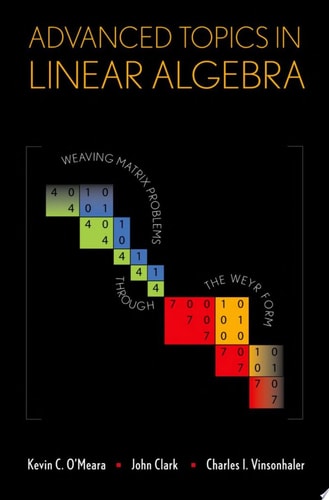
Advanced Topics in Linear Algebra: Weaving Matrix Problems through the Weyr Form
0
0
As an Amazon Associate and affiliate partner, Menrva Books earns from qualifying purchases. Learn more
Author Description
The Weyr matrix canonical form is a largely unknown cousin of the Jordan canonical form. Discovered by Eduard Weyr in 1885, the Weyr form outperforms the Jordan form in a number of mathematical situations, yet it remains somewhat of a mystery, even to many who are skilled in linear algebra. Written in an engaging style, this book presents various advanced topics in linear algebra linked through the Weyr form. Kevin O'Meara, John Clark, and Charles Vinsonhaler develop the Weyr form from scratch and include an algorithm for computing it. A fascinating duality exists between the Weyr form and the Jordan form. Developing an understanding of both forms will allow students and researchers to exploit the mathematical capabilities of each in varying situations. Weaving together ideas and applications from various mathematical disciplines, Advanced Topics in Linear Algebra is much more than a derivation of the Weyr form. It presents novel applications of linear algebra, such as matrix commutativity problems, approximate simultaneous diagonalization, and algebraic geometry, with the latter two having topical connections to phylogenetic invariants in biomathematics and multivariate interpolation. Among the related mathematical disciplines from which the book draws ideas are commutative and noncommutative ring theory, module theory, field theory, topology, and algebraic geometry. Numerous examples and current open problems are included, increasing the book's utility as a graduate text or as a reference for mathematicians and researchers in linear algebra.
Menrva's Summary
THE THESIS
This text investigates the mathematical utility and theoretical properties of the Weyr canonical form as a superior alternative to the traditional Jordan canonical form in specific linear algebra applications. The authors, Charles Vinsonhaler, John L. Clark, and Kevin O'Meara, leverage their expertise in algebra to provide a comprehensive derivation of the Weyr form from first principles. By establishing a duality between the Weyr and Jordan forms, the book provides a robust framework for researchers to select the most efficient matrix representation for complex computational and theoretical problems.
THE SCOPE MAP
What You Will Find
- A step-by-step algorithmic approach for computing the Weyr canonical form.
- Comparative analysis of matrix commutativity problems and simultaneous diagonalization techniques.
- Applications of linear algebra in algebraic geometry, biomathematics, and multivariate interpolation.
- Theoretical connections to module theory, ring theory, and field theory.
THE AUTHORITY PERSPECTIVE
Experts identify this work as a specialized resource that bridges the gap between classical linear algebra and advanced algebraic research. Readers frequently note the high level of technical density, making it a suitable reference for graduate-level students and professional mathematicians.
Page Count:
432
Publication Date:
2011-01-01
Publisher:
Oxford University Press
ISBN-10:
019987817X
ISBN-13:
9780199878178
Linear Algebra
Mathematics Statistics
Algebraic Geometry
textbook
Mathematics
Mathematics - General
Reference
Community Tags
Similar Books