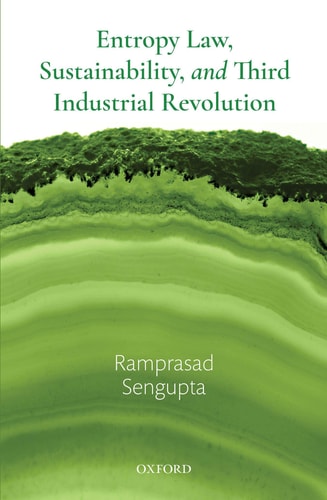
Entropy Law, Sustainability, and Third Industrial Revolution
0
0
As an Amazon Associate and affiliate partner, Menrva Books earns from qualifying purchases. Learn more
Author Description
In mankind's relentless quest for prosperity, Nature has suffered great damage. It has been treated as an inexhaustible reserve of resources. The indefinite scale of global expansion is still continued and now the earth's very survival is under threat. But against this exploitation of nature, there is a concept of Entropy that places a finite limit on the extent to which resources can be used in any closed system, such as our planet. Considering the impact of entropy, this book examines the key issues of sustainability-social, economic, and environmental. It discusses the social dimension of sustainability, showing how it is impacted by issues of economic inequality, poverty, and other socio-economic and infrastructural factors in the Indian context. It also highlights how Indian households suffer from clean energy poverty and points to the inequality in distribution of different fuels and of fuel cost among households. It assesses India's power sector and its potential to be a significant player in bringing the third industrial revolution in India by replacing fossil fuels to new renewables. It concludes by projecting power sector scenarios till 2041-42 achievable through alternative, realizable policy with respect to energy conservation and fuel substitution, and thus paving the way for the green power.
Menrva's Summary
THE THESIS
This book investigates the fundamental conflict between indefinite global economic expansion and the physical constraints imposed by the law of entropy on a finite planet. Author Ramprasad Sengupta utilizes thermodynamic principles to critique current resource exploitation models. He argues that sustainability requires a transition toward renewable energy systems, specifically focusing on the socio-economic landscape of India to demonstrate how energy poverty and inequality hinder development.
THE SCOPE MAP
What You Will Find
- Analysis of the entropy law as a constraint on economic growth
- Evaluation of the Indian power sector and its transition potential
- Assessment of energy poverty and fuel distribution inequality
- Projections for power sector scenarios through 2041-42
Scope Limits
- The analysis is primarily focused on the Indian socio-economic and infrastructural context
- Does not provide a global policy framework for non-developing nations
THE AUTHORITY PERSPECTIVE
Experts recognize this work as a rigorous application of thermodynamic theory to contemporary economic policy. Readers frequently note the academic density of the prose and the specific focus on Indian energy infrastructure as a case study for broader sustainability challenges.
Page Count:
296
Publication Date:
2020-01-01
Publisher:
Oxford University Press
ISBN-10:
0190121149
ISBN-13:
9780190121143
Economics
Energy policy
Economic History
Industrial history
Sustainability
India
Community Tags
Similar Books