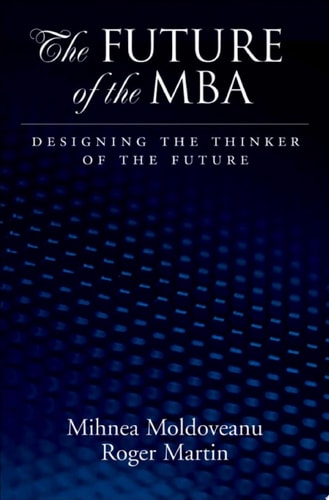
The Future of the MBA: Designing the Thinker of the Future
0
0
As an Amazon Associate and affiliate partner, Menrva Books earns from qualifying purchases. Learn more
Author Description
The MBA is probably the hottest ticket among the current university graduate degree offerings--every year, more than 120,000 students enroll in MBA programs in the United States, and the estimates in Europe do not lag far behind. In addition, job prospects have never looked better for business school graduates; corporations are hiring more business school graduates every year, and compensating them more handsomely.The Future of the MBA provides a sorely needed detailed and systematic review of the major contemporary debates on management education. At the same time, it makes a striking new proposal that will certainly have an impact in business schools: that managers need to develop a series of qualitative tacit skills which could be appropriately developed by integrative curricula brought from different disciplines, including sociology, philosophy, and other social sciences. Moldoveanu and Martin, both involved in the greatly respected integrative business education program at the Rotheman School of Management, provide a guide on how to design a reliable integrated program for management students. One of the main assets of the book is that it relies not just on speculative thinking, but on real life experience, and that it also includes case studies that will appeal to practicing managers. As an authoritative reference on MBA education, it will appeal to faculty and staff of business schools, as well as students in related fields like education and public policy.
Menrva's Summary
THE THESIS
This book investigates the critical question of how management education must evolve to effectively prepare future leaders for the complexities of the modern business landscape. Authors Mihnea C. Moldoveanu and Roger L. Martin, both prominent figures at the Rotman School of Management, argue that traditional MBA curricula are insufficient for developing the qualitative, tacit skills required by contemporary corporations. They propose a shift toward integrative curricula that synthesize insights from sociology, philosophy, and the social sciences to foster a more holistic form of business thinking.
THE SCOPE MAP
What You Will Find
- A systematic review of contemporary debates surrounding the efficacy and structure of management education.
- A proposed framework for designing integrative curricula that bridge business studies with the humanities and social sciences.
- Case studies derived from real-world experience at the Rotman School of Management to illustrate practical application.
- Methodologies for developing tacit, qualitative leadership skills in graduate students.
THE AUTHORITY PERSPECTIVE
Experts and faculty members recognize this work as a significant contribution to the discourse on pedagogical reform within business schools. Readers frequently note the practical utility of the authors' proposed integrative model for those involved in curriculum design and administrative policy.
Page Count:
156
Publication Date:
2008-01-01
Publisher:
Oxford University Press
ISBN-10:
0199887659
ISBN-13:
9780199887651
Business
Professional Development
Consumer Education
Higher Education
Management
Education
Community Tags
Similar Books