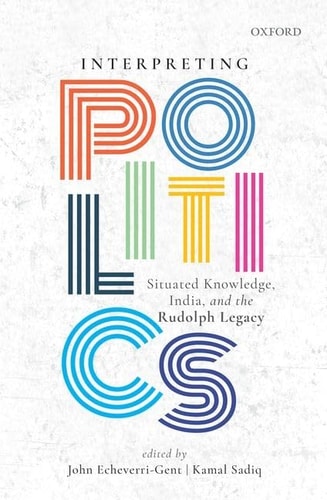
Interpreting Politics: Situated Knowledge, India, and the Rudolph Legacy
0
0
As an Amazon Associate and affiliate partner, Menrva Books earns from qualifying purchases. Learn more
Author Description
Review "This volume brings together the best minds in the field to celebrate the scholarly legacy of Susanne and Lloyd Rudolph and advance their own novel contributions. Erudite and intelligent, the essays ought to attract the attention of specialists in Indian politics and those interested in interpretive approaches in the social sciences." -- Atul Kohli, David K.E. Bruce Professor of international affairs, Princeton University, USA"What a bounty! Stimulated by the deep intellectual legacy of two remarkable scholars and teachers, this rich harvest advances our knowledge of their cherished India while both broadening and intensifying our means as students of comparative politics. Like the Rudolphs, these essays refuse any simple binary distinguishing interpretive social science from analytical considerations of political institutions, social structures, and political economy." -- Ira Katznelson, Ruggles Professor of political science and history, Columbia University, USA; President, American Political Science Association, 2005-6"This book uses deep contextual knowledge to address vital issues in comparative politics institutions, violence, identity, class, culture and leadership. It is a fitting tribute to Lloyd and Susanne Rudolph, social scientists who demonstrated the value of situated knowledge in what they wrote and how they lived." -- Kanchan Chandra, professor of politics, New York University, USA"An invaluable demonstration of how humanistic social science can provide potent insights into the most challenging developments in India and the world today." -- Rogers Smith, Christopher H. Browne Distinguished Professor of political science, University of Pennsylvania, USA; President, American Political Science Association, 2018-19 Product Description In careers that spanned six decades, Lloyd and Susanne Rudolph's rigorous and remarkably empathetic scholarship produced seminal insights about India's politics. With a profound grasp of social science theory and Indian politics, they developed an interpretive mode of political analysis centred on the complex processes by which people construct meaning and motivation for political action.This volume's eminent authors pay tribute to the Rudolphs' scholarship by examining its contribution to their own cutting-edge research as they advance the frontiers of the study of Indian politics and social science writ large. Their engaging essays analyse how 'situated knowledge' shapes discourse, moral imagination, political strategies, and institutional change. They illuminate how the interaction of caste, class, gender, and religion structures political mobilization; how changing social and political relations affect education policy and civil-military relations; and how political leadership is forging the future of politics in India. About the Author John Echeverri Gent, Associate Professor, Department of Politics, University of Virginia, Kamal Sadiq, Associate Professor, Department of Political Science, University of California, IrvineJohn Echeverri-Gent is associate professor in the Department of Politics at the University of Virginia. He is author of The State and the Poor: Public Policy and Political Development in India and the United States and co-editor of Economic Reform in Three Giants: U.S. Foreign Policy and the USSR, China, and India. His many articles in comparative public policy and the political economy of development have appeared in Perspectives on Politics; PS: Political Science and Politics; World Development; Policy Studies Journal; Asian Survey; Contemporary South Asia; India Review; and Political Science Quarterly. He is a member of the editorial board of Political Science Quarterly. He has served as consultant to the World Bank and USAID. Kamal Sadiq (PhD, University of Chicago) is associate professor of political science at the University of California, Irvine. He is the author of Paper Citizens: How Illegal Immigrants Acquire Citizenship
Menrva's Summary
THE THESIS
This volume investigates the enduring impact of the Rudolphs' scholarship on the study of Indian politics and the broader application of interpretive social science. The editors, John Echeverri-Gent and Kamal Sadiq, curate a collection of essays from leading scholars to analyze how the Rudolphs' methodology—centered on situated knowledge—continues to inform contemporary political inquiry. By bridging the gap between interpretive approaches and structural analysis, the book argues for the continued relevance of the Rudolphs' intellectual framework in understanding complex political institutions and social dynamics.
THE SCOPE MAP
What You Will Find
- Analysis of political institutions, violence, identity, class, culture, and leadership in India.
- Theoretical frameworks for integrating interpretive social science with political economy.
- Scholarly reflections on the legacy of Susanne and Lloyd Rudolph's six-decade career.
Scope Limits
- The text does not provide a comprehensive biography of the Rudolphs' personal lives.
- It does not serve as an introductory textbook for general Indian history, focusing instead on specialized political science discourse.
THE AUTHORITY PERSPECTIVE
Experts in the field of comparative politics recognize this volume as a significant contribution to the study of Indian political systems and interpretive methodology. Scholars frequently note that the text serves as both a tribute to the Rudolphs' intellectual rigor and a functional resource for researchers applying situated knowledge to modern political challenges.
Page Count:
403
Publication Date:
2020-11-18
Publisher:
Oxford University Press
ISBN-10:
0190125012
ISBN-13:
9780190125011
Comparative Politics
India Studies
Academic Biography
Social Science
Community Tags
Similar Books



Reader Comments
Share Your Thoughts
No comments yet. Be the first to share your thoughts!