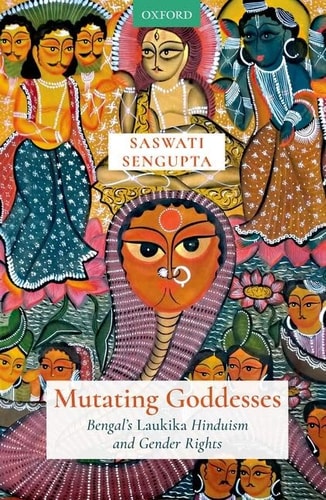
Mutating Goddesses: Bengal's Laukika Hinduism and Gender Rights
0
0
As an Amazon Associate and affiliate partner, Menrva Books earns from qualifying purchases. Learn more
Author Description
Product Description Mutating Goddesses traces the shifting fortunes of four specific Hindu deities - Manasa, Candi, Sasthi and Laksmi--- from the fifteenth century to the present time. It focuses on the goddess-invested tradition of Bengal's Hinduism to argue for a historical evolution/devolution of divinities in tandem with sectarian interests and illumines in the process the knotted correlation of gender, caste and class in the sanctioning of female subjectivities through goddess formation. The critical studies of Hindu goddesses have been dominated by the sastrik perspective deriving from the Sanskrit scriptures authorized by the male Brahman. But there are religious practices and beliefs under the broad rubric of Hinduism that are neither governed by the male Brahman nor articulated in Sanskrit. It is this vibrant laukika archive-- - considered low from the hegemonic perspective---that Mutating Goddesses explores to realize the politic trafficking between this realm and the sastrik. The book excavates the multiple and layered heritage of the region which includes tribal culture, Buddhism, Tantricism, and so on, as is available in rituals, proverbs, verses, circulating myths, poetic genres and kathas, caste manuals, census records etc to illustrate how tradition is a matter of strategic selection. About the Author Saswati Sengupta, Associate Professor, Department of English, Miranda HouseSaswati Sengupta has been teaching English literature at Miranda House, Delhi University, for more than thirty years. Her primary research and academic publications have been feminist interventions in the areas of myths, Hindu goddesses and their material locations, mutations and political mobilizations. Believing in, and enjoying, collective endeavour she has jointly published papers analyzing the problems of foregrounding post-colonial theories in understanding contemporary India and co-edited the anthologies Towards Freedom: Critical Essays on Rabindranath Tagore's Ghare Baire/The Home and the World, 2007, Revisiting Kalidasa's Abhijnana-Sakuntalam: Love, Lineage and Language in Kalidasa's Nataka, 2011, and Bad Women of Bombay Films: Studies in Desire and Anxiety, forthcoming 2019. Saswati's novel, The Song Seekers (2011) was listed for DSC prize for South Asian Literatures, 2013.
Menrva's Summary
THE THESIS
This work investigates how the historical evolution of four specific Hindu deities—Manasa, Candi, Sasthi, and Laksmi—reflects the shifting intersections of gender, caste, and class within Bengal's Laukika Hinduism. Dr. Saswati Sengupta, an Associate Professor at Miranda House, Delhi University, utilizes her extensive background in feminist literary and cultural studies to challenge the male-Brahmanical dominance of traditional Sanskrit-based scholarship. By analyzing the 'laukika' or folk archive, she argues that the formation and mutation of these goddesses are strategic processes influenced by sectarian interests and political power dynamics.
THE SCOPE MAP
What You Will Find
- Historical analysis of four specific deities from the 15th century to the present.
- Examination of non-Sanskritic religious practices, including tribal influences, Buddhism, and Tantricism.
- Methodology incorporating diverse primary sources such as rituals, proverbs, poetic genres, kathas, caste manuals, and census records.
Scope Limits
- The study is geographically restricted to the Bengal region and its specific cultural heritage.
- It does not focus on the mainstream Sastrik or Sanskrit-authorized theological perspectives, except where they intersect with the folk tradition.
THE AUTHORITY PERSPECTIVE
Scholars and readers frequently note the academic rigor and depth of the author's archival research into regional folk traditions. Experts highlight this text as a significant contribution to feminist interventions in the study of Hindu mythology and material culture.
Page Count:
375
Publication Date:
2020-08-04
Publisher:
Oxford University Press
ISBN-10:
0190124105
ISBN-13:
9780190124106
Religion
Cultural History
Sociology
Hinduism
Gender Studies
Asian Studies
Community Tags
Similar Books

Reader Comments
Share Your Thoughts
No comments yet. Be the first to share your thoughts!