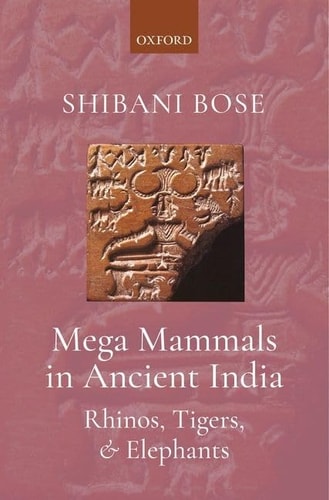
Mega Mammals in Ancient India: Rhinos, Tigers, and Elephants
0
0
As an Amazon Associate and affiliate partner, Menrva Books earns from qualifying purchases. Learn more
Author Description
The book ventures to look into eras bygone in order to chronicle the passage of three mega species-the rhinoceros, tiger, and elephant across millennia in early north India. It carefully sifts through an archive comprising faunal remains and visual depictions retrieved from the archaeological record as well as a gamut of Sanskrit, Pali, Prakrit, and classical Western accounts to document the presence of these big mammals in various cultural niches from hunter-gatherer societies to the first urban civilization of India and beyond. The narrative goes beyond treating these species as mere cultural icons to one that is also sensitive to their importance as markers of ecology. The focus is two-fold: to comprehend perceptions, attitudes, and sensibilities oscillating between veneration and persecution in order to reconstruct the cultural dimensions of human-megafaunal relations in the past, as also to use these species to understand the larger ecology of ancient India.At a time when the conservation of our megafaunal heritage is a major concern for biologists, ecologists as well as conservationists, this book underlines the need to historicize human interactions with these mega mammals keeping in mind that an animal's past is critical in thinking about its future.
Menrva's Summary
THE THESIS
How did the historical relationship between humans and megafauna—specifically rhinoceroses, tigers, and elephants—shape the ecological and cultural landscape of ancient North India? Dr. Shibani Bose utilizes a multidisciplinary approach, synthesizing archaeological evidence, faunal remains, and textual analysis from Sanskrit, Pali, Prakrit, and classical Western sources. The author argues that these species functioned as both cultural icons and critical ecological markers, necessitating a historical perspective to inform modern conservation efforts.
THE SCOPE MAP
What You Will Find
- Analysis of faunal remains and visual depictions from the archaeological record.
- Examination of literary accounts across multiple ancient languages.
- A dual-focus framework evaluating human attitudes ranging from veneration to persecution.
Scope Limits
- The study is geographically restricted to early North India.
- The text does not provide a comprehensive biological manual for modern species management.
THE AUTHORITY PERSPECTIVE
Scholars and historians recognize this work as a significant contribution to the field of environmental history in South Asia. Readers frequently note the academic rigor of the cross-disciplinary methodology employed to bridge the gap between archaeology and ecology.
Page Count:
382
Publication Date:
2020-09-02
Publisher:
Oxford University Press
ISBN-10:
019012041X
ISBN-13:
9780190120412
History
Natural History
Environmental History
Ancient India
Ecology
NATURE Ecology
Zoology
Kindle Store
Categories
Kindle eBooks
India
Asia
Archaeology
Community Tags
Similar Books