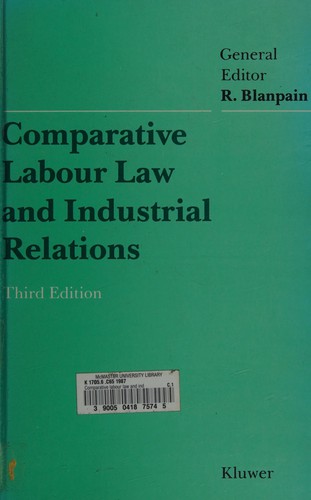
Comparative Labour Law and Industrial Relations in Industrialized Market Economies
0
0
As an Amazon Associate and affiliate partner, Menrva Books earns from qualifying purchases. Learn more
Author Description
Comparativism is no longer a purely academic exercise but has increasingly become an urgent necessity for industrial relations and legal practitioners due to the growth of multinational enterprises and the impact of international and regional organizations aspiring to harmonize rules. The growing need for comprehensive, up-to-date and readily available information on labour law and industrial relations in different countries led to the publication of the 'International Encyclopaedia for Labour Law and Industrial Relations', in which more than 70 international and national monographs have thus far been published. 0This book goes a step further than the 'Encyclopaedia' in as much as most of the chapters provide comparative and integrated thematic treatment. The aim is to describe the salient characteristics and trends in labour law and industrial relations in the contemporary world. This book is obviously not exhaustive, with respect to the coverage of countries and topics. The authors limit themselves mainly to the industrialized market economies. The book is divided in four main parts: an introduction relating to methodology and documentation, including the use of Internet. The second part concerns international actors, like the International Employer#x92;s Organisations and the International Trade Union Movement, as well as Human Resources Management. The third concerns the sources of regulation, concentrating on International and European Labour Law, as well as on Codes of Conduct for Multinational Enterprises and describes also the rules in case of conflict of laws. The last part deals with international developments and comparative studies in not less than 14 chapters.
Menrva's Summary
THE THESIS
This book investigates the evolving landscape of labor law and industrial relations within industrialized market economies, driven by globalization and the need for comparative legal understanding. The author, R. Blanpain, draws upon extensive research, including contributions to the 'International Encyclopaedia for Labour Law and Industrial Relations,' to provide a comparative and integrated thematic treatment of the subject. The work focuses on industrialized market economies, acknowledging its scope is not exhaustive in terms of countries or topics. It is structured into four parts: an introduction to methodology and documentation, a section on international actors and human resources management, a part detailing sources of regulation including international and European labor law, and finally, comparative studies across 14 chapters.
THE SCOPE MAP
- Methodology and documentation for comparative labor law research, including the use of the Internet.
- Analysis of international actors such as Employer's Organizations and the Trade Union Movement.
- Exploration of Human Resources Management in an international context.
- Examination of the sources of regulation, specifically International and European Labour Law.
- Discussion of Codes of Conduct for Multinational Enterprises.
- Rules concerning conflict of laws in labor relations.
- Comparative studies across 14 distinct chapters focusing on industrialized market economies.
THE AUTHORITY PERSPECTIVE
The book is presented as a necessary academic and practical resource for understanding labor law and industrial relations in a globalized world, building upon the extensive 'International Encyclopaedia for Labour Law and Industrial Relations'. Its comparative and thematic approach aims to describe salient characteristics and trends in contemporary industrialized market economies. The authors acknowledge the book's limitations in country and topic coverage, focusing primarily on industrialized market economies. The structure is designed to offer a comprehensive overview, starting with methodology and moving through international actors, regulatory sources, and detailed comparative studies.
Page Count:
664
Publication Date:
2004-01-01
ISBN-10:
9041122893
Non-Fiction
History
Politics
Labor Law
Comparative Law
Industrial Relations
Community Tags
Similar Books