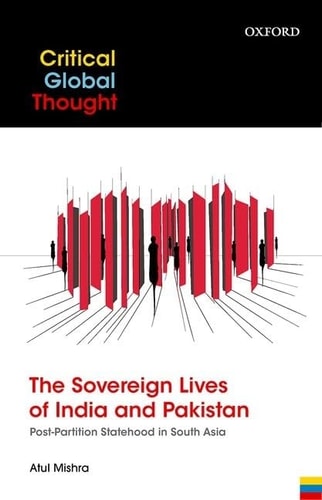
The Sovereign Lives of India and Pakistan: Post-Partition Statehood in South Asia
0
0
As an Amazon Associate and affiliate partner, Menrva Books earns from qualifying purchases. Learn more
Author Description
This book explores what it has meant for India and Pakistan to act as sovereign states entangled at birth by an unsatisfactory partition. Sovereignty is conventionally understood as a means to achieve the goals that states set for themselves. The book argues that for India and Pakistan, sovereignty has become an end in itself, and that its pursuit has aided majoritarianism, insecurity, and mutual estrangement.The book examines the trajectory of three problems that the partition of 1947 bequeathed to the two states. It investigates the state-minority relations, national identity debates, and contestation over Kashmir to outline the parallel processes of minoritization, homogenization, and territorialization. It shows how these processes signify the two states' quest for sovereignty. The scholarship on India and Pakistan often privileges their bilateral relations. In contrast, this book carries out the deeper task of a single-frame analysis and critique of their intertwined statehoods.Ultimately, the book shows the inadequacy of the nation state form as the basis for political community on the subcontinent. It concludes by pointing to the contemporary relevance of alternative ideas of sovereignty and political community for South Asia that were articulated during the first half of the 20th century.
Menrva's Summary
THE THESIS
This book investigates how the pursuit of sovereignty has transformed into an end in itself for India and Pakistan, shaping their internal politics and mutual antagonism. Atul Mishra, a scholar of international relations and political theory, utilizes a single-frame comparative analysis to examine the post-partition trajectories of both nations. He argues that the obsession with sovereign statehood has exacerbated majoritarianism, national insecurity, and the systematic marginalization of minorities within both borders.
THE SCOPE MAP
What You Will Find
- Analysis of state-minority relations and national identity formation post-1947.
- Examination of the Kashmir conflict as a manifestation of territorialization.
- Critique of the nation-state model as a framework for South Asian political community.
- Historical review of alternative sovereignty concepts from the early 20th century.
Scope Limits
- The book does not focus on bilateral diplomatic negotiations or traditional conflict resolution strategies.
- It does not provide a comprehensive history of the 1947 partition event itself.
THE AUTHORITY PERSPECTIVE
Scholars and political analysts recognize this work as a significant contribution to the critique of post-colonial statehood in South Asia. Readers frequently note the academic density of the prose and the author's rigorous departure from traditional bilateral diplomatic history.
Page Count:
280
Publication Date:
2022-01-18
Publisher:
Oxford University Press
ISBN-10:
0190130873
ISBN-13:
9780190130879
History
Asian Studies
Asia history
International relations
Statehood
Community Tags
Similar Books