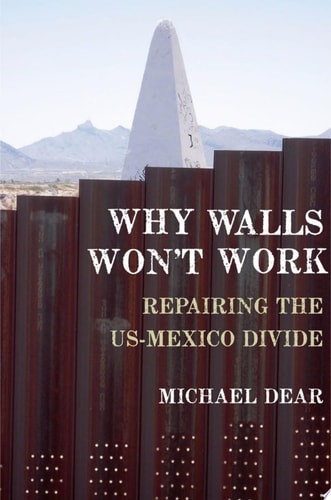
Why Walls Won't Work
0
0
As an Amazon Associate and affiliate partner, Menrva Books earns from qualifying purchases. Learn more
Author Description
When Thinking About The Border Separating The United States From Mexico, What Typically Comes To Mind Is An Unwelcoming Zone With Violent, Poverty-ridden Towns, Cities, And Maquiladoras On One Side And An Increasingly Militarized Network Of Barriers And Surveillance Systems On The Other. It Was Not Always This Way. In Fact, From The End Of Mexican-american War Until The Late Twentieth Century, The Border Was A Very Porous And Loosely Regulated Region. In This Sweeping Account Of Life Within The United States-mexican Border Zone, Acclaimed Urbanist And Geographer Michael Dear Traces The Border's Long History Of Cultural Interaction, From Exchanges Between The Region's Numerous Mesoamerican Tribes Onwards. Once Mexican And American Settlers Met At The Rio Grande And The Southwest In The Nineteenth Century, New Forms Of Interaction Evolved. But As Dear Warns In His Bracing Study, This Vibrant Zone Of Cultural And Social Amalgamation Is In Danger Of Fading Away Because Of Highly Restrictive American Policies And The Violence Along Mexico's Side Of The Border. As He Explains Through Analyses Of The U.s. Border Security Complex And The Emerging Mexican Narco-state, The Very Existence Of The Third Nation Occupied By Both Americans And Mexicans Is Under Serious Threat. But Through A Series Of Evocative Portraits Of Contemporary Border Communities, He Shows That The Potential For Revitalizing This In-between Nation Still Remains. Combining A Broad Historical Perspective And A Commanding Overview Of Present-day Problems, Why Walls Won't Work Represents A Major Intellectual Foray Into One Of The Most Hotly Contested Political Issues Of Our Era.
Menrva's Summary
THE THESIS
This book investigates the historical evolution and contemporary erosion of the United States-Mexico border region, arguing that restrictive security policies threaten the unique cultural amalgamation known as the 'Third Nation.' Michael Dear, a distinguished urbanist and geographer, utilizes a blend of historical analysis, sociological observation, and geopolitical critique to examine how the border transitioned from a porous, interactive zone to a militarized barrier. He posits that the current security-focused approach ignores the deep-rooted social and economic interdependencies that have defined the region for centuries. By contrasting the historical reality of the border with modern political rhetoric, Dear provides a framework for understanding the potential for regional revitalization.
THE SCOPE MAP
What You Will Find
- Historical analysis of the U.S.-Mexico border from the post-Mexican-American War era to the present.
- Examination of the U.S. border security complex and its impact on regional social dynamics.
- Case studies and evocative portraits of contemporary border communities.
- Analysis of the socio-political pressures exerted by the emerging Mexican narco-state.
THE AUTHORITY PERSPECTIVE
Experts recognize this work as a significant contribution to border studies, valued for its interdisciplinary approach that bridges urban geography and political history. Readers frequently note the clarity with which the author connects broad policy shifts to the lived experiences of residents in the borderlands.
Page Count:
320
Publication Date:
2013-01-01
Publisher:
Oxford University Press, Incorporated
ISBN-10:
0199897999
ISBN-13:
9780199897995
History
International relations
Sociology
Geography
Urban Studies
Community Tags
Similar Books