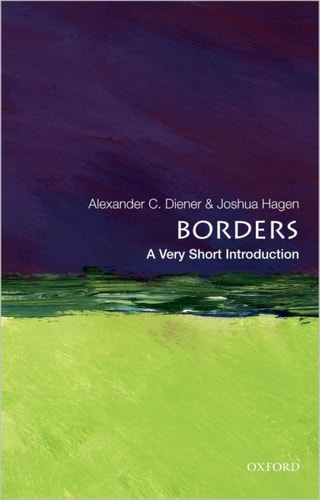
Borders: A Very Short Introduction
0
0
As an Amazon Associate and affiliate partner, Menrva Books earns from qualifying purchases. Learn more
Author Description
Compelling and accessible, this Very Short Introduction challenges the perception of borders as passive lines on a map, revealing them instead to be integral forces in the economic, social, political, and environmental processes that shape our lives. Highlighting the historical development and continued relevance of borders, Alexander Diener and Joshua Hagen offer a powerful counterpoint to the idea of an imminent borderless world, underscoring the impact borders have on a range of issues, such as economic development, inter- and intra-state conflict, global terrorism, migration, nationalism, international law, environmental sustainability, and natural resource management. Diener and Hagen demonstrate how and why borders have been, are currently, and will undoubtedly remain hot topics across the social sciences and in the global headlines for years to come. This compact volume will appeal to a broad, interdisciplinary audience of scholars and students, including geographers, political scientists, anthropologists, sociologists, historians, international relations and law experts, as well as lay readers interested in understanding current events.
Menrva's Summary
THE THESIS
This book investigates the fundamental role of borders as active, transformative agents in global economic, social, and political processes rather than merely static lines on a map. Authors Alexander C. Diener and Joshua Hagen, both established scholars in geography and border studies, utilize a multidisciplinary framework to argue that borders remain essential to understanding modern statecraft and human interaction. They synthesize historical context with contemporary geopolitical data to demonstrate why the concept of a borderless world remains largely theoretical and disconnected from current global realities.
THE SCOPE MAP
What You Will Find
- Historical evolution of border demarcation and territorial sovereignty.
- Analysis of the intersection between borders and global migration patterns.
- Examination of how borders influence environmental sustainability and resource management.
- Case studies on the relationship between border security, nationalism, and international law.
THE AUTHORITY PERSPECTIVE
Experts and scholars frequently cite this volume as a concise, foundational entry point for students and lay readers interested in political geography. The text is noted for its ability to distill complex geopolitical theories into an accessible format without sacrificing academic rigor.
Page Count:
152
Publication Date:
2012-01-01
Publisher:
Oxford University Press
ISBN-10:
0199912653
ISBN-13:
9780199912650
History
Earth Sciences
Geography
International relations
Sociology
Boundaries
Political Anthropology
Community Tags
Other Editions(4)

Similar Books