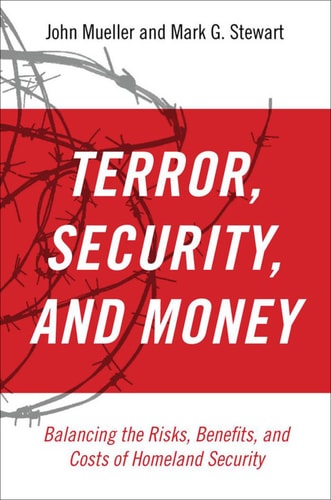
Terror, Security, and Money: Balancing the Risks, Benefits, and Costs of Homeland Security
0
0
As an Amazon Associate and affiliate partner, Menrva Books earns from qualifying purchases. Learn more
Author Description
In seeking to evaluate the efficacy of post-9/11 homeland security expenses--which have risen by more than a trillion dollars, not including war costs--the common query has been, "Are we safer?" This, however, is the wrong question. Of course we are "safer"--the posting of a single security guard at one building's entrance enhances safety. The correct question is, "Are any gains in security worth the funds expended?"In this engaging, readable book, John Mueller and Mark Stewart apply risk and cost-benefit evaluation techniques to answer this very question. This analytical approach has been used throughout the world for decades by regulators, academics, and businesses--but, as a recent National Academy of Science study suggests, it has never been capably applied by the people administering homeland security funds. Given the limited risk terrorism presents, expenses meant to lower it have for the most part simply not been worth it. For example, to be considered cost-effective, increased American homeland security expenditures would have had each year to have foiled up to 1,667 attacks roughly like the one intended on Times Square in 2010--more than four a day. Cataloging the mistakes that the US has made--and continues to make--in managing homeland security programs, Terror, Security, and Money has the potential to redirect our efforts toward a more productive and far more cost-effective course.
Menrva's Summary
THE THESIS
This book investigates whether the massive financial expenditures on post-9/11 homeland security measures are justified by the actual reduction in risk they provide. Authors John Mueller and Mark G. Stewart, both experts in political science and risk assessment, utilize established cost-benefit analysis frameworks to scrutinize government spending. They argue that current security policies often fail to meet standard economic efficiency criteria, suggesting that the resources allocated to these programs frequently outweigh the potential threats they are intended to mitigate.
THE SCOPE MAP
What You Will Find
- Quantitative cost-benefit analysis of post-9/11 security spending.
- Comparative risk assessment methodologies used by regulators and businesses.
- Case studies evaluating the efficacy of specific counter-terrorism measures.
- Critical examination of government resource allocation and policy decision-making.
THE AUTHORITY PERSPECTIVE
Experts and policy analysts frequently cite this work as a critical, data-driven challenge to conventional wisdom regarding national security spending. Readers often note the accessible yet rigorous nature of the authors' economic arguments, which provide a clear framework for evaluating public safety investments.
Page Count:
281
Publication Date:
2011-01-01
Publisher:
Oxford University Press
ISBN-10:
0199912289
ISBN-13:
9780199912285
Economics
Civil Engineering
International Security
Public Administration
Engineering
Public Policy
National security
Professional Career & Trade
Community Tags
Similar Books