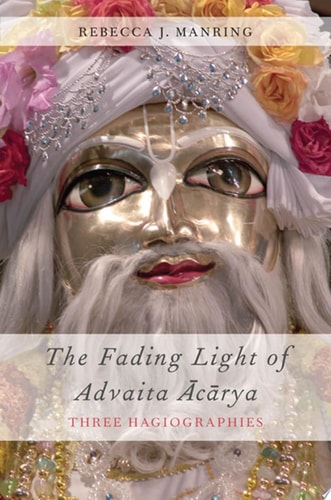
The Fading Light of Advaita Acarya: Three Hagiographies
0
0
As an Amazon Associate and affiliate partner, Menrva Books earns from qualifying purchases. Learn more
Author Description
Rebecca J. Manring offers an illuminating study and translation of three hagiographies of Advaita Acarya, a crucial figure in the early years of the devotional Vaisnavism which originated in Bengal in the fifteenth century. Advaita Acarya was about fifty years older than the movement's putative founder, Caitanya, and is believed to have caused Caitanya's advent by ceaselessly storming heaven, calling for the divine presence to come to earth. Advaita was a scholar and highly respected pillar of society, whose status lent respectability and credibility to the new movement. A significant body of hagiographical and related literature about Advaita Acarya has developed since his death, some as late as the early twentieth century. The three hagiographic texts included in The Fading Light of Advaita Acarya examine the years of Advaita's life that did not overlap with Caitanya's lifetime, and each paints a different picture of its protagonist. Each composition clearly advocates the view that Advaita was himself divine in some way, and a few go so far as to suggest that Advaita reflected even greater divinity than Caitanya, through miraculous stories that can be found nowhere else in Bengali Vaisnava literature. Manring provides a detailed introduction to these texts, as well as remarkably faithful translations of Haricarana Dasa's Advaita Mangala, Laudiya Krsnadasa's Balya-lila-sutra, and Isana Nagara's Advaita Prakasa.
Menrva's Summary
THE THESIS
How do distinct hagiographical accounts of Advaita Acarya shape the theological understanding of his divinity and his role in the emergence of Bengali Vaisnavism? Rebecca J. Manring, an expert in religious studies, utilizes these primary source translations to analyze the historical and spiritual significance of a figure who predated and facilitated the movement founded by Caitanya. The work provides a critical framework for understanding how hagiography functions as both a historical record and a tool for theological assertion within the Vaisnava tradition.
THE SCOPE MAP
What You Will Find
- Translations of three primary hagiographical texts: Advaita Mangala, Balya-lila-sutra, and Advaita Prakasa.
- Historical analysis of the fifteenth-century Bengali religious landscape.
- Examination of the theological arguments asserting Advaita Acarya's divine status.
- Comparative study of narrative variations across different hagiographic accounts.
THE AUTHORITY PERSPECTIVE
Scholars recognize this volume as a significant contribution to the study of regional Vaisnava literature and the history of religious movements in Bengal. Readers frequently note the academic rigor of the translations and the clarity with which Manring contextualizes these complex hagiographical narratives for a contemporary audience.
Page Count:
312
Publication Date:
2011-01-01
Publisher:
Oxford University Press
ISBN-10:
0199911274
ISBN-13:
9780199911271
Biography
History
Religion
Hinduism
Priests
Academic
Translation
Community Tags
Similar Books