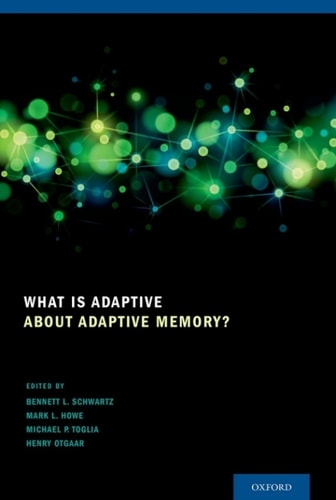
What Is Adaptive about Adaptive Memory?
0
0
As an Amazon Associate and affiliate partner, Menrva Books earns from qualifying purchases. Learn more
Author Description
Human memory, like other biological systems, has been subject to natural selection over the course of evolution. However, cognitive systems do not fossilize, which means that current researchers must infer evolutionary influences on human memory from current human behavior rather than from fossils or artifacts. Examining the potential for cognition as adaptation has often been ignored by cognitive psychology. Recently, a number of researchers have identified variables that affect human memory that may reflect these ancestral influences. These include survival processing, future-oriented processing, spatial memory, cheater detection, face memory and a variety of social influences on memory. The current volume grew out of discussion at the symposium on survival processing at the SARMAC conference in June 2011, in New York City. The goal of this volume will be to present the best theoretical and empirical work on the adaptive nature of memory. It features the most current work of a number of cognitive psychologists, developmental psychologists, comparative psychologists and cognitive neuroscientists, who have focused on this issue. This is important because much this work is necessarily interdisciplinary and is therefore spread out across a range of journals and conferences.
Menrva's Summary
THE THESIS
This volume investigates the core question of how human memory functions as an evolved biological adaptation shaped by natural selection. The authors, including Bennett L. Schwartz and Mark L. Howe, synthesize interdisciplinary research from cognitive, developmental, and comparative psychology to address the lack of fossil evidence for cognitive evolution. By examining current human behavior, the text establishes a framework for understanding how ancestral pressures continue to influence modern memory processes.
THE SCOPE MAP
What You Will Find
- Theoretical and empirical analysis of survival-based memory processing
- Examination of future-oriented cognition and spatial memory mechanisms
- Discussion of social influences including face recognition and cheater detection
- Synthesis of interdisciplinary research from cognitive neuroscience and developmental psychology
THE AUTHORITY PERSPECTIVE
Experts identify this volume as a critical resource for consolidating disparate research on evolutionary memory theory into a single, accessible text. Readers frequently note the academic density of the prose, which serves as a foundational reference for students and researchers in the field of cognitive psychology.
Page Count:
352
Publication Date:
2013-01-01
Publisher:
Oxford University Press
ISBN-10:
0199928061
ISBN-13:
9780199928064
Self-help
Psychology
Self Help
Evolutionary Psychology
Neuroscience
Academic
Community Tags
Similar Books







![Instructor's resource manual to accompany Biology, 3nd edition [by] Karen Arms, Pamela S. Camp](https://storage.googleapis.com/menrva_img_storage/covers/generated/9780030036477.jpg)