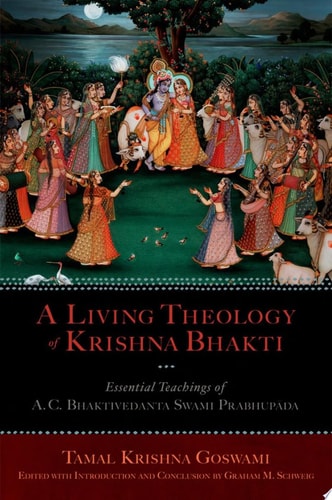
A Living Theology of Krishna Bhakti: Essential Teachings of A. C. Bhaktivedanta Swami Prabhupada
0
0
As an Amazon Associate and affiliate partner, Menrva Books earns from qualifying purchases. Learn more
Author Description
A. C. Bhaktivedanta Swami Prabhupada (1896-1977), founder of the Hare Krishna Movement, traced his lineage to the fifteenth-century Indian saint Sri Chaitanya. He authored more than fifty volumes of English translation and commentaries on Sanskrit and Bengali texts, serving as a medium between these distant authorities and his modern Western readership and using his writings as blueprints for spiritual change and a revolution in consciousness. He had to speak the language of a people vastly disparate from the original recipients of his tradition's scriptures without compromising fidelity to the tradition. Tamal Krishna Goswami claims that the social scientific, philosophical, and 'insider' forms of investigation previously applied have failed to explain the presence of a powerful interpretative device-a mahavakya or 'great utterance'-that governs and pervades Prabhupada's 'living theology' of devotion on bhakti. For Prabhupada, the wide range of 'vedic' subject matter is governed by the axiomatic truth: Krishna is the Supreme Personality of Godhead. Goswami's academic training at the University of Cambridge, his thirty years' experience as a practitioner and teacher, and his extensive interactions with Prabhupada as both personal secretary and managerial representative, afforded him a unique opportunity to understand and illuminate the theological contribution of Prabhupada. In this work, Goswami proves that the voice of the scholar-practitioner can be intimately connected with his tradition while sustaining a mature critical stance relative to his subject. A Living Theology of Krishna Bhakti includes a critical introduction and conclusion by Graham M. Schweig.
Menrva's Summary
THE THESIS
This work investigates the core interpretative device that governs the theological framework of A. C. Bhaktivedanta Swami Prabhupada’s teachings on Krishna Bhakti. Tamal Krishna Goswami, a scholar-practitioner with extensive personal experience as Prabhupada’s secretary, utilizes his academic training from the University of Cambridge to analyze how Prabhupada translated ancient Sanskrit and Bengali scriptures for a modern Western audience. The author argues that a singular 'great utterance'—the axiom that Krishna is the Supreme Personality of Godhead—serves as the foundational principle that unifies the vast array of Vedic subject matter within the Hare Krishna movement.
THE SCOPE MAP
What You Will Find
- An analysis of the theological methodology used by A. C. Bhaktivedanta Swami Prabhupada.
- A study of the 'mahavakya' or 'great utterance' as an interpretative tool.
- A synthesis of insider practitioner experience and academic critical inquiry.
Scope Limits
- The text focuses specifically on the theological contributions of Prabhupada rather than a comprehensive historical biography of the entire Hare Krishna movement.
- It does not provide a general introduction to all schools of Hindu thought, remaining centered on the Bhakti tradition.
THE AUTHORITY PERSPECTIVE
Scholars and practitioners recognize this work as a significant bridge between academic religious studies and internal theological discourse. Experts highlight the author's unique position as both a devoted follower and a trained academic, which allows for a rigorous yet empathetic examination of the subject matter.
Page Count:
297
Publication Date:
2012-01-01
Publisher:
Oxford University Press
ISBN-10:
0190207795
ISBN-13:
9780190207793
Biography
Philosophy
Religion
Hinduism
Theology
Bhakti