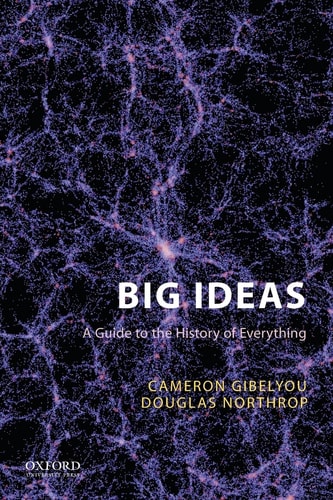
Big Ideas: A Guide to the History of Everything
0
0
As an Amazon Associate and affiliate partner, Menrva Books earns from qualifying purchases. Learn more
Author Description
Big Ideas: A Guide to the History of Everything narrates the history of the universe, Earth, life, and humanity while analyzing how grand stories about the past, present, and future are crafted and framed.In Big Ideas, authors Cameron Gibelyou and Douglas Northrop create a novel framework for thinking about the history and future of everything. They grapple throughout the book with issues at the intersection of the natural sciences, history, literature, philosophy, religion, and the humanities. In nine elegantly written chapters, they attempt to make a reasoned analysis of worldviews that underlie historical writing across many fields. Throughout the course of their broad and deep explorations, the authors bring a wide range of voices to bear on fascinating questions of where everything--from the universe as a whole to any particular thing within it--came from, how it got to be the way it is today, and where things might be headed in the future.Big Ideas invites readers to think about genuinely big questions carefully and rigorously, separating received narratives about the "history of everything" from the basic facts discovered by scientific and historical study. The book treats scientific explanation and humanistic interpretation as partners: inviting those with primarily scientific interests into a humanistic discussion about science and history, and encouraging those with core interests in the humanities into a discussion of how humanities-based ways of thinking might connect with and apply to the natural sciences. This engagement helps readers learn a basic narrative of the "history of everything" while constantly provoking thought about big questions and the field of Big History.
Menrva's Summary
THE THESIS
This book investigates how grand narratives of the universe, Earth, and humanity are constructed and how they shape our understanding of the past, present, and future. Authors Cameron Gibelyou and Douglas Northrop, drawing on their expertise in history and the sciences, propose a framework that bridges the gap between natural science and humanistic inquiry. They argue that by separating established cultural narratives from empirical scientific and historical data, readers can develop a more rigorous and reasoned perspective on the history of everything.
THE SCOPE MAP
What You Will Find
- A nine-chapter analysis of worldviews underlying historical writing.
- A cross-disciplinary framework connecting natural sciences, literature, philosophy, and religion.
- An examination of the origins of the universe, the development of life, and the trajectory of human history.
Scope Limits
- The text does not provide an exhaustive chronological history of every event in time.
- It does not attempt to resolve all metaphysical questions but rather focuses on the analytical framing of historical narratives.
THE AUTHORITY PERSPECTIVE
Readers and scholars frequently note the book's success in synthesizing complex interdisciplinary concepts into an accessible format. Experts highlight this as a valuable resource for those seeking to understand the methodological foundations of the Big History field.
Page Count:
464
Publication Date:
2020-07-31
Publisher:
Oxford University Press
ISBN-10:
0190201215
ISBN-13:
9780190201210
Non-Fiction
Philosophy
Science
World history
Humanities
Big History
Civilization
Community Tags
Similar Books