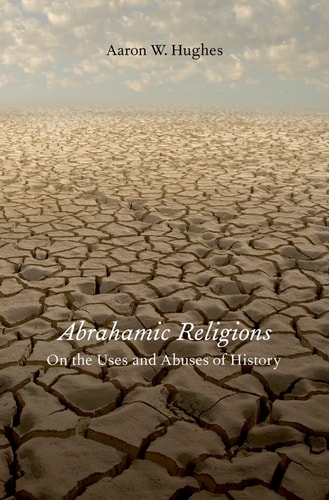
Abrahamic Religions: On the Uses and Abuses of History
0
0
As an Amazon Associate and affiliate partner, Menrva Books earns from qualifying purchases. Learn more
Author Description
Recently, the term "Abrahamic religions" has been used with exceeding frequency in the academy. We now regularly encounter academic books, conferences, and even positions (including endowed chairs) devoted to the so-called "Abrahamic religions." But what exactly are "Abrahamic religions"? Although many perceive him as the common denominator of Judaism, Christianity, and Islam, Abraham remains deceptively out of reach. An ahistorical figure, some contend he holds the seeds for historical reconciliation. Touted as symbol of ecumenicism, Abraham can just as easily function as one of division and exclusivity. Like our understanding of Abraham, the category "Abrahamic religions" is vague and nebulous. In Abrahamic Religions, Aaron Hughes examines the creation and dissemination of this term.Usually lost in contemporary discussions is a set of crucial questions: Where does the term "Abrahamic religions" derive? Who created it and for what purposes? What sort of intellectual work is it perceived to perform? Part genealogical and part analytical, this book seeks to raise and answer questions about the appropriateness and usefulness of employing "Abrahamic religions" as a vehicle for understanding and classifying data. In so doing, Abrahamic Religions can be taken as a case study that examines the construction of categories within the academic study of religion, showing how the categories we employ can become more an impediment than an expedient to understanding.
Menrva's Summary
THE THESIS
This book investigates the historical origins, academic utility, and potential intellectual pitfalls of the category "Abrahamic religions." Aaron W. Hughes, a scholar of religious studies, utilizes a genealogical and analytical framework to deconstruct how the term has evolved from a vague concept into a standard academic classification. He argues that the term often obscures more than it reveals, functioning as an ahistorical construct that can inadvertently promote division rather than the intended ecumenical reconciliation.
THE SCOPE MAP
What You Will Find
- A genealogical analysis of the term "Abrahamic religions" within academic discourse.
- A critique of how religious categories are constructed and disseminated in modern scholarship.
- Case studies examining the figure of Abraham as a symbol of both unity and exclusivity.
- Methodological inquiries into the efficacy of classification systems in the study of religion.
THE AUTHORITY PERSPECTIVE
Scholars and students of religious studies frequently cite this work as a critical intervention in the methodology of comparative religion. Experts highlight the text's rigorous academic density and its challenge to established nomenclature in the field.
Page Count:
208
Publication Date:
2012-11-15
Publisher:
Oxford University Press
ISBN-10:
0199934649
ISBN-13:
9780199934645
Philosophy
Religion
History
Religions
Academic
Theology
Community Tags
Similar Books