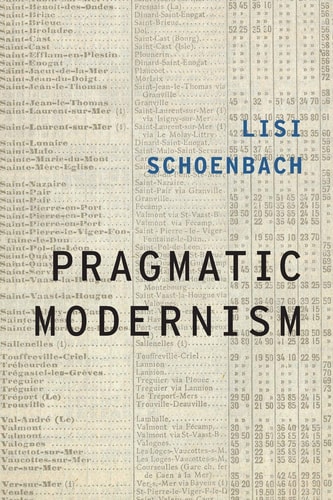
Pragmatic Modernism
0
0
As an Amazon Associate and affiliate partner, Menrva Books earns from qualifying purchases. Learn more
Author Description
Modernism has long been understood as a radical repudiation of the past. Reading against the narrative of modernism-as-break, Pragmatic Modernism traces an alternative strain of modernist thought that grows out of pragmatist philosophy and is characterized by its commitment to gradualism, continuity, and recontextualization. It rediscovers a distinctive response to the social, intellectual, and artistic transformations of modernity in the work of Henry James, Marcel Proust, Gertrude Stein, Oliver Wendell Holmes, John Dewey, and William James. These thinkers share an institutionally-grounded approach to change which emphasizes habits, continuities, and daily life over spectacular events, heroic opposition, and radical rupture. They developed an active, dialectical attitude that was critical of complacency while refusing to romanticize moments of shock or conflict.Through its analysis of pragmatist keywords, including "habit," "institution," "prediction," and "bigness," Pragmatic Modernism offers new readings of works by James, Proust, Stein, and Andre Breton, among others. It shows, for instance, how Stein's characteristic literary innovation--her repetitions--aesthetically materialize the problem of habit; and how institutions--businesses, museums, newspapers, the law, and even the state itself--help to construct the subtlest of personal observations and private gestures in James's novels.This study reconstructs an overlooked strain of modernism. In so doing, it helps to re-imagine the stark choice between political quietism and total revolution that has been handed down as modernism's legacy.
Menrva's Summary
THE THESIS
This book investigates whether modernism can be understood as a philosophy of continuity and gradualism rather than a radical break from the past. Lisi Schoenbach, a scholar of modernist literature and culture, challenges the prevailing narrative of modernism as a movement defined by rupture. By synthesizing pragmatist philosophy with literary analysis, she argues that a specific strain of modernist thought prioritizes habits, institutions, and daily life as mechanisms for navigating the transformations of modernity.
THE SCOPE MAP
What You Will Find
- Analysis of pragmatist keywords including habit, institution, prediction, and bigness
- Comparative study of literary figures such as Henry James, Marcel Proust, and Gertrude Stein
- Integration of philosophical perspectives from John Dewey, William James, and Oliver Wendell Holmes
- Examination of institutional structures like the law, museums, and the state in literary contexts
Scope Limits
- The study does not focus on the radical, revolutionary, or shock-oriented aspects of modernism
- It does not provide a comprehensive survey of all modernist writers, focusing instead on those aligned with pragmatist thought
THE AUTHORITY PERSPECTIVE
Scholars and critics recognize this work as a significant intervention in modernist studies that successfully complicates the traditional binary of quietism versus revolution. Readers frequently note the academic density of the prose, which is intended for an audience familiar with both literary theory and pragmatist philosophy.
Page Count:
218
Publication Date:
2014-12-01
Publisher:
Oxford University Press
ISBN-10:
0190207345
ISBN-13:
9780190207342
Philosophy
Modernism
Modernism aesthetics
Social change
European
Pragmatism
American
Habit
Literary Criticism
Community Tags
Other Editions(4)


Similar Books


Reader Comments
Share Your Thoughts
No comments yet. Be the first to share your thoughts!