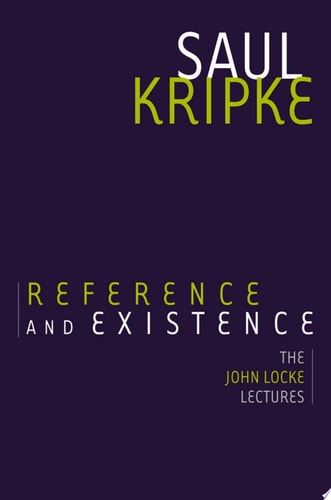
Reference and Existence: The John Locke Lectures
0
0
As an Amazon Associate and affiliate partner, Menrva Books earns from qualifying purchases. Learn more
Author Description
Reference and Existence, Saul Kripke's John Locke Lectures for 1973, can be read as a sequel to his classic Naming and Necessity. It confronts important issues left open in that work -- among them, the semantics of proper names and natural kind terms as they occur in fiction and in myth; negative existential statements; the ontology of fiction and myth (whether it is true that fictional characters like Hamlet, or mythical kinds like bandersnatches, might have existed). In treating these questions, he makes a number of methodological observations that go beyond the framework of his earlier book -- including the striking claim that fiction cannot provide a test for theories of reference and naming. In addition, these lectures provide a glimpse into the transition to the pragmatics of singular reference that dominated his influential paper, "Speaker's Reference and Semantic Reference" -- a paper that helped reorient linguistic and philosophical semantics. Some of the themes have been worked out in later writings by other philosophers -- many influenced by typescripts of the lectures in circulation -- but none have approached the careful, systematic treatment provided here. The virtuosity of Naming and Necessity -- the colloquial ease of the tone, the dazzling, on-the-spot formulations, the logical structure of the overall view gradually emerging over the course of the lectures -- is on display here as well.
Menrva's Summary
THE THESIS
This work investigates the semantic and ontological status of proper names and natural kind terms as they appear within fictional and mythical contexts. Saul A. Kripke, a prominent figure in analytic philosophy, utilizes these 1973 lectures to address unresolved questions from his earlier work, Naming and Necessity. He constructs a framework that challenges existing theories of reference, specifically examining how negative existential statements and the existence of fictional entities function within linguistic and philosophical systems.
THE SCOPE MAP
What You Will Find
- Analysis of the semantics of proper names and natural kind terms in fiction and myth
- Examination of negative existential statements and their logical implications
- Discussion on the ontology of fictional characters and mythical entities
- Methodological observations regarding the limitations of fiction as a test for theories of reference
Scope Limits
- The text does not provide a comprehensive history of analytic philosophy
- It does not cover the entirety of Kripke's later philosophical contributions beyond the scope of these specific lectures
THE AUTHORITY PERSPECTIVE
Experts recognize this text as a foundational expansion of Kripke's earlier work, providing essential context for his influence on linguistic and philosophical semantics. Readers frequently note the technical density of the prose, which requires a strong background in formal logic and analytic philosophy to fully grasp the arguments presented.
Page Count:
185
Publication Date:
2013-01-01
Publisher:
Oxford University Press
ISBN-10:
0190208058
ISBN-13:
9780190208059
Philosophy
Reference Philosophy
Ontology
Language
Semantics
Metaphysics
Logic
Community Tags
Similar Books