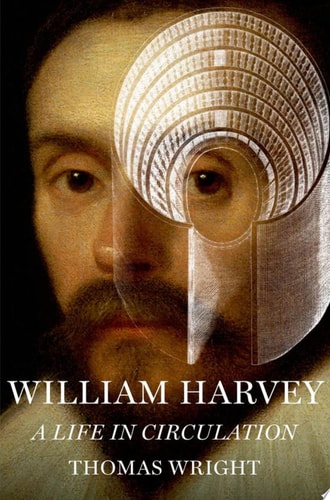
William Harvey: A Life in Circulation
0
0
As an Amazon Associate and affiliate partner, Menrva Books earns from qualifying purchases. Learn more
Author Description
In 1628, the English physician William Harvey published his revolutionary theory of blood circulation. Offering a radical conception of the workings of the human body and the function of the heart, Harvey's theory overthrew centuries of anatomical and physiological orthodoxy and had profound consequences for the history of science. It also had an enormous impact on culture more generally, influencing economists, poets and political thinkers, for whom the theory triumphed not as empirical fact but as a remarkable philosophical idea.In the first major biographical study of Harvey in 50 years, Thomas Wright charts the meteoric rise of a yeoman's son to the elevated position of King Charles I's physician, taking the reader from farmlands of Kent to England's royal palaces, and paints a vivid portrait of an extraordinary mind formed at a fertile time in England's intellectual history. Set in late Renaissance London, the book features an illustrious cast of historical characters, from Francis Bacon and John Donne to Robert Fludd, whose corroboration of Harvey's ideas helped launch his circulation theory. After he published his discoveries, Harvey became famous throughout Europe, where he demonstrated his theory through public vivisections. Although his ideas met with vociferous opposition, they eventually triumphed and Harvey became renowned as the only man in the history of natural philosophy to live to see a revolutionary theory gain wide currency. But just as intellectual ideas could be toppled, so too could kings. When Charles I was overthrown during the Civil War of the 1640s, his loyal court physician fell also, and Harvey, an unrepentant Royalist, was banished from London under the English Republic. He died in the late 1650s, a gout-ridden, melancholy man, uncertain of his achievement. A victim of the political turmoil of the times, William Harvey was nevertheless the mainspring of vast historical changes in anatomy and physiology.
Menrva's Summary
THE THESIS
How did William Harvey’s discovery of blood circulation fundamentally alter the trajectory of both medical science and the broader intellectual landscape of the seventeenth century? Thomas Wright, a historian of science, utilizes primary source documents and historical context to reconstruct the life of the physician who challenged centuries of established anatomical dogma. The book argues that Harvey’s work was not merely a biological breakthrough but a philosophical shift that resonated through the political and cultural spheres of the English Renaissance.
THE SCOPE MAP
What You Will Find
- A detailed examination of the medical and anatomical theories prevalent in the early seventeenth century.
- An analysis of the social and political climate of England during the reign of King Charles I and the subsequent Civil War.
- Biographical accounts of Harvey’s interactions with intellectual contemporaries such as Francis Bacon and John Donne.
- A study of the transition from traditional natural philosophy to empirical scientific methodology.
THE AUTHORITY PERSPECTIVE
Historians and scholars of science recognize this work as a comprehensive and long-overdue biographical treatment of a pivotal figure in medical history. Readers frequently note the balance between technical medical detail and the broader political narrative of the English Civil War.
Page Count:
288
Publication Date:
2012-01-01
Publisher:
Oxford University Press
ISBN-10:
0199977011
ISBN-13:
9780199977017
Science
Biography
Non-Fiction
History
Renaissance
Physiologists
Medicine
Allied Health
Blood_circulation
Great Britain
Medical
Health Professions
Physicians biography
Community Tags
Similar Books