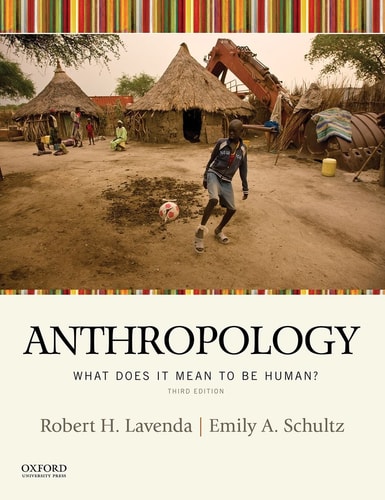
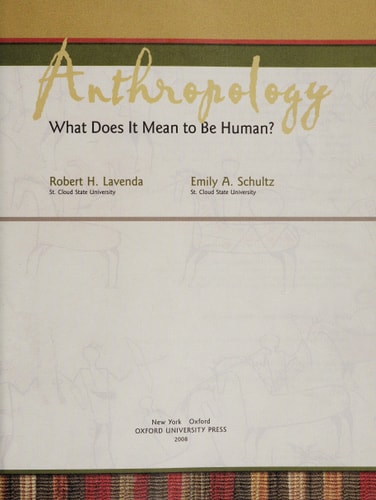
Anthropology: What Does It Mean to Be Human?
0
0
As an Amazon Associate and affiliate partner, Menrva Books earns from qualifying purchases. Learn more
Author Description
A unique alternative to more traditional, encyclopedic introductory texts, Anthropology: What Does It Mean to Be Human?, Third Edition, takes a question-oriented approach that incorporates cutting-edge theory and new ways of looking at important contemporary issues such as power, human rights, and inequality. With a total of sixteen chapters, this engaging, full-color text is an ideal one-semester overview that delves deep into anthropology without overwhelming students.
Menrva's Summary
THE THESIS
This text investigates the fundamental question of what it means to be human by utilizing a question-oriented framework rather than a traditional encyclopedic approach. Authors Emily A. Schultz and Robert H. Lavenda leverage their extensive academic backgrounds to synthesize complex anthropological theories into an accessible format. The book focuses on contemporary issues such as power dynamics, human rights, and social inequality to provide a modern lens on the human experience. By centering the narrative on inquiry, the authors encourage students to engage with anthropological concepts as active tools for understanding global society.
THE SCOPE MAP
What You Will Find
- Comprehensive coverage of the four-field approach to anthropology
- Theoretical frameworks regarding power, inequality, and human rights
- Sixteen chapters designed for a one-semester academic course
- Full-color illustrations and pedagogical aids
Scope Limits
- Does not provide exhaustive encyclopedic detail on every sub-discipline
- Focuses primarily on introductory concepts rather than advanced specialized research
THE AUTHORITY PERSPECTIVE
Educators frequently utilize this text for its ability to balance theoretical rigor with student accessibility. Experts highlight the question-oriented structure as a successful method for maintaining engagement in introductory undergraduate courses.
Page Count:
576
Publication Date:
2014-11-21
Publisher:
Oxford University Press
ISBN-10:
0190210842
ISBN-13:
9780190210847
Social Science
Archaeology
Anthropology
Physical Anthropology
textbook
Cultural Anthropology
Community Tags
Other Editions(3)
Similar Books