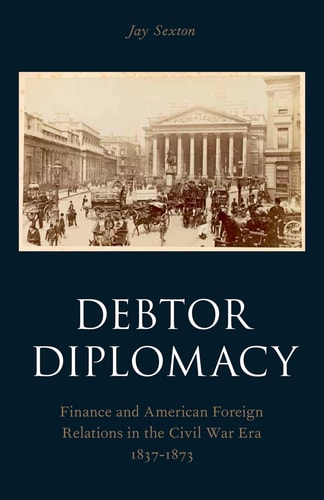
Debtor Diplomacy: Finance and American Foreign Relations in the Civil War Era, 1837-1873
0
0
As an Amazon Associate and affiliate partner, Menrva Books earns from qualifying purchases. Learn more
Author Description
The United States was a debtor nation in the mid-nineteenth century, with half of its national debt held overseas. Lacking the resources to develop the nation and to fund the wars necessary to expand and then preserve it, the United States looked across the Atlantic for investment capital. The need to obtain foreign capital greatly influenced American foreign policy, principally relations with Britain. The intersection of finance and diplomacy was particularly evident during the Civil War when both the North and South integrated attempts to procure loans from European banks into their larger international strategies. Furthermore, the financial needs of the United States (and the Confederacy) imparted significant political power to an elite group of London-based financiers who became intimately involved in American foreign relations during this period. This study explores and assesses how the United State's need for capital influenced its foreign relations in the tumultuous years wedged between the two great financial crises of the nineteenth century, 1837 to 1873.Drawing on the unused archives of London banks and the papers of statesmen on both sides of the Atlantic, this work illuminates our understanding of mid-nineteenth-century American foreign relations by highlighting how financial considerations influenced the formation of foreign policy and functioned as a peace factor in Anglo-American relations. This study also analyzes a crucial, but ignored, dimension of the Civil War - the efforts of both the North and the South to attract the support of European financiers. Though foreign contributions to each side failed to match the hopes of Union and Confederate leaders, the financial diplomacy of the Civil War shaped the larger foreign policy strategies of both sides and contributed to both the preservation of British neutrality and the ultimate defeat of the Confederacy.
Menrva's Summary
THE THESIS
This study investigates how the United States' reliance on foreign capital between 1837 and 1873 fundamentally shaped its diplomatic strategies and foreign policy decisions. Jay Sexton, a historian specializing in nineteenth-century international relations, utilizes previously untapped archival materials from London banking institutions and the personal papers of transatlantic statesmen. He argues that the necessity of securing European investment, particularly from British financiers, acted as a critical constraint and influence on American policy, including the strategic maneuvers of both the Union and the Confederacy during the Civil War.
THE SCOPE MAP
What You Will Find
- Analysis of the financial interdependence between the United States and British capital markets.
- Examination of the role of London-based financiers in influencing American political decisions.
- Investigation into the financial diplomacy strategies employed by both the North and the South during the Civil War.
- Assessment of how capital requirements functioned as a deterrent to conflict and a factor in maintaining British neutrality.
Scope Limits
- The study is strictly bounded by the financial crises of 1837 and 1873.
- It focuses primarily on Anglo-American financial and diplomatic relations rather than broader global economic trends.
THE AUTHORITY PERSPECTIVE
Historians and scholars of the Civil War era frequently cite this work for its rigorous archival research and its contribution to understanding the intersection of high finance and statecraft. Readers often note the academic density of the prose, which is tailored for students and researchers of nineteenth-century diplomatic history.
Page Count:
304
Publication Date:
2014-11-01
Publisher:
Clarendon Press
ISBN-10:
0190212586
ISBN-13:
9780190212582
History
Economic History
19th Century
American History
Civil War
Diplomatic History
Community Tags
Similar Books