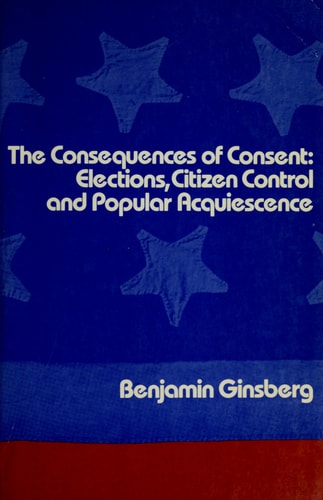
The Consequences of Consent: Elections, Citizen Control and Popular Acquiescence
0
0
As an Amazon Associate and affiliate partner, Menrva Books earns from qualifying purchases. Learn more
Author Description
Elections As Institutions Of Governance -- Elections And The Socialization Of Mass Political Activity -- Electionis And The Institutionalization Of Popular Influence -- Elections And The Acquisition Of Political Power -- Mass Participation As A Source Of National Authority -- Elections And The State's Powers -- Epilogue: Elections, Liberty, And The Consequences Of Consent. Benjamin Ginsberg. Includes Bibliographical References And Index.
Menrva's Summary
THE THESIS
This work investigates the paradox of modern elections, questioning whether they serve as genuine instruments of popular control or as mechanisms for state-managed acquiescence. Benjamin Ginsberg, a professor of political science, utilizes historical analysis and institutional theory to argue that elections often function to socialize mass political activity rather than empower the citizenry. He examines how the institutionalization of voting processes can inadvertently expand state power while simultaneously limiting the scope of effective public influence.
THE SCOPE MAP
What You Will Find
- Analysis of elections as institutional frameworks for governance
- Examination of how political participation is socialized and managed
- Historical assessment of the relationship between voting and national authority
- Evaluation of the impact of electoral processes on individual liberty and state power
THE AUTHORITY PERSPECTIVE
Experts frequently cite this text as a foundational critique of democratic institutions and the limitations of electoral participation. Readers often note the academic density of the prose, which provides a rigorous framework for understanding the intersection of state power and mass political behavior.
Page Count:
271
Publication Date:
1982-01-01
Publisher:
Addison Wesley Publishing Company
ISBN-10:
0201040794
ISBN-13:
9780201040791
Elections
Government
Political Theory
Representative government and representation
Sociology
Community Tags
Similar Books