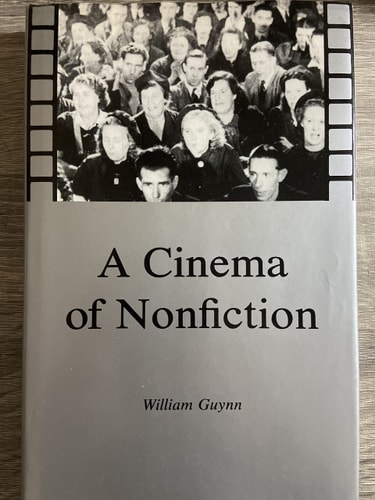
A Cinema of Nonfiction
0
0
As an Amazon Associate and affiliate partner, Menrva Books earns from qualifying purchases. Learn more
Author Description
This work explores the meaning of the traditional distinction made between fiction and nonfiction film, and whether documentary film is a separate form of discourse with its own history and signifying structures. Methodologies developed by semiology are used, particularly those of Christian Metz. More than seventy illustrations.
Menrva's Summary
THE THESIS
This work investigates the fundamental distinction between fiction and nonfiction film, questioning whether documentary film constitutes a distinct mode of discourse with its own unique history and structures of meaning. The author, William Howard Guynn, utilizes semiological methodologies, particularly those developed by Christian Metz, to analyze filmic language. The book examines how documentary films construct their reality and convey meaning, challenging conventional categorizations.
THE SCOPE MAP
- An exploration of the theoretical underpinnings distinguishing fiction and nonfiction cinema.
- Application of semiological methodologies, specifically Christian Metz's theories, to film analysis.
- Analysis of documentary film as a separate discourse with its own historical development and signifying structures.
- Examination of the historical evolution and unique characteristics of documentary filmmaking.
- Discussion of how documentary films represent reality and construct meaning for audiences.
- Over seventy illustrations to support the textual analysis.
THE AUTHORITY PERSPECTIVE
This work is recognized for its rigorous application of semiotic theory to the study of documentary film, offering a sophisticated framework for understanding its unique characteristics. Scholars in film studies and media theory engage with Guynn's arguments regarding the discourse of nonfiction cinema. The book is considered a valuable contribution to the theoretical discourse surrounding film classification and the nature of cinematic representation.
Page Count:
249
Publication Date:
1990-01-01
Publisher:
UNKNO
ISBN-10:
0838633404
ISBN-13:
9780838633403
Non-Fiction
Art
Film Studies
Semiotics
Documentary Film
Film Theory
Community Tags
Similar Books