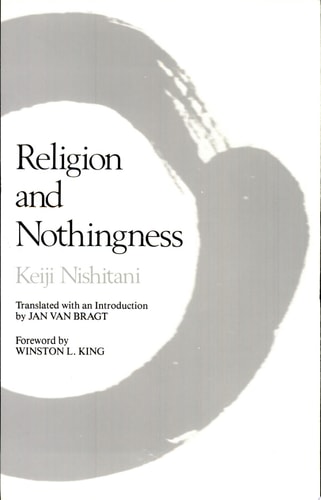
Religion and Nothingness
0
0
As an Amazon Associate and affiliate partner, Menrva Books earns from qualifying purchases. Learn more
Author Description
In Religion and Nothingness the leading representative of the Kyoto School of Philosophy lays the foundation of thought for a world in the making, for a world united beyond the differences of East and West. Keiji Nishitani notes the irreversible trend of Western civilization to nihilism, and singles out the conquest of nihilism as the task for contemporary philosophy. Nihility, or relative nothingness, can only be overcome by being radicalized to Emptiness, or absolute nothingness. Taking absolute nothingness as the fundamental notion in rational explanations of the Eastern experience of human life, Professor Nishitani examines the relevance of this notion for contemporary life, and in particular for Western philosophical theories and religious believes. Everywhere his basic intention remains the same: to direct our modern predicament to a resolution through this insight. The challenge that the thought of Keiji Nishitani presents to the West, as a modern version of an Eastern speculative tradition that is every bit as old and as variegated as our own, is one that brings into unity the principle of reality and the principle of salvation. In the process, one traditional Western idea after another comes under scrutiny: the dichotomy of faith and reason, of being and substance, the personal and transcendent notions of God, the exaggerated role given to the knowing ego, and even the Judeo-Christian view of history itself. Religion and Nothingness represents the major work of one of Japan's most powerful and committed philosophical minds.
Menrva's Summary
THE THESIS
Keiji Nishitani confronts the pervasive nihilism of Western civilization by radicalizing it to absolute nothingness. As a leading figure of the Kyoto School, Nishitani argues that this absolute nothingness, or Emptiness, is the key to overcoming the modern predicament and uniting Eastern and Western thought. He examines the relevance of this concept for contemporary life, challenging traditional Western philosophical and religious notions, including the dichotomy of faith and reason, the nature of God, and the role of the ego.
THE SCOPE MAP
- Analysis of Western civilization's trend towards nihilism.
- The concept of Emptiness (absolute nothingness) as a resolution.
- Relevance of Eastern philosophical experience to contemporary life.
- Critique of Western philosophical theories and religious beliefs.
- Examination of the dichotomy between faith and reason.
- Re-evaluation of transcendent and personal notions of God.
- Discussion on the role of the knowing ego and the Judeo-Christian view of history.
THE AUTHORITY PERSPECTIVE
This seminal work by Keiji Nishitani, a prominent philosopher of the Kyoto School, is recognized for its profound engagement with the problem of nihilism in Western thought. It is regarded as a significant attempt to bridge Eastern and Western philosophical traditions by positing absolute nothingness as a means of overcoming existential despair. The book challenges fundamental tenets of Western philosophy and religion, offering a unique perspective on the modern human condition.
Page Count:
317
Publication Date:
1982-01-01
Publisher:
University of California Press
ISBN-10:
0520049462
ISBN-13:
9780520049468
Non-Fiction
Philosophy
Religion
Western philosophy
nihilism
Eastern Philosophy
Community Tags
Similar Books