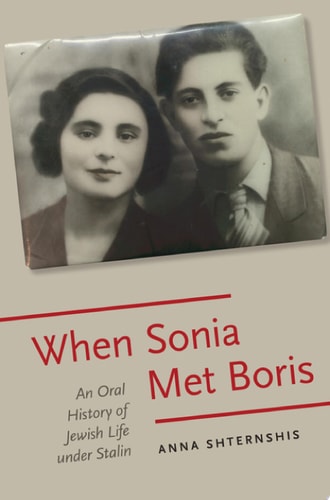
When Sonia Met Boris
0
0
As an Amazon Associate and affiliate partner, Menrva Books earns from qualifying purchases. Learn more
Author Description
Soviet Jews lived through a record number of traumatic events: the Great Terror, World War II, the Holocaust, the famine of 1947, the Doctors' Plot, the antisemitic policies of the postwar period, and the collapse of the Soviet Union. But like millions of other Soviet citizens, they married, raised children, and built careers, pursuing life as best as they could in a profoundly hostile environment. One of the first scholars to record and analyze oral testimonies of Soviet Jews, Anna Shternshis unearths their everyday life and the difficult choices that they were forced to make as a repressed minority living in a totalitarian regime. Drawing on nearly 500 interviews with Soviet citizens who were adults by the 1940s, When Sonia Met Boris describes both indirect Soviet control mechanisms—such as housing policies and unwritten quotas in educational institutions—and personal strategies to overcome, ignore, or even take advantage of those limitations. The interviews reveal how ethnicity was rapidly transformed into a negative characteristic, almost a disability, for Soviet Jewry in the postwar period. Ultimately, Shternshis shows, after decades living in a repressive, nominally atheistic state, these Jews did manage to retain a complex sense of Jewish identity, but one that fully disassociates Jewishness from Judaism and instead associates it with secular society, prioritizing chess over Talmud, classical music over Hasidic tunes. Gracefully weaving together poignant stories, intimate reflections, and witty anecdotes, When Sonia Met Boris traces the unusual contours of contemporary Russian Jewish identity back to its roots.
Menrva's Summary
THE THESIS
This work investigates how Soviet Jews maintained a distinct cultural identity while navigating the systemic repression and state-mandated secularism of the Soviet Union. Anna Shternshis, a scholar specializing in Yiddish and Soviet Jewish history, utilizes a vast archive of nearly 500 oral history interviews to reconstruct the lived experiences of individuals who reached adulthood during the 1940s. The book argues that Jewish identity in this context was redefined through secular pursuits and survival strategies rather than religious practice, effectively decoupling Jewishness from Judaism.
THE SCOPE MAP
What You Will Find
- Analysis of Soviet control mechanisms including housing policies and educational quotas.
- Examination of the transformation of ethnicity into a social disability in the postwar period.
- Qualitative data derived from extensive oral history interviews with Soviet citizens.
Scope Limits
- The study focuses primarily on the experiences of those who were adults by the 1940s.
- The text does not provide a comprehensive political history of the Soviet state, focusing instead on individual social navigation.
THE AUTHORITY PERSPECTIVE
Scholars and historians frequently cite this work as a significant contribution to the understanding of Jewish life under totalitarian regimes. Readers often note the balance between academic rigor and the intimate, humanizing nature of the personal narratives presented throughout the text.
Page Count:
256
Publication Date:
2017-01-01
Publisher:
Oxford University Press
ISBN-10:
0190223111
ISBN-13:
9780190223113
History
Soviet History
Oral History
Sociology
Jewish Studies
Community Tags
Similar Books