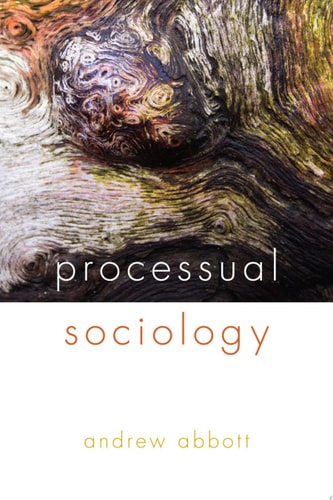
Processual Sociology
0
0
As an Amazon Associate and affiliate partner, Menrva Books earns from qualifying purchases. Learn more
Author Description
Andrew Abbott has been, for the last 20 years, elaborating what he terms a processual ontology for social life. It dovetails with his quest to find ways for the disciplines of history and sociology to be able to talk about the same subject matter, i.e., as different versions of looking at the same thing By a processual approach, Abbott means an approach that presumes that everything in the social world is continuously in the process of making, remaking, and unmaking itself (and other things), instant by instant. A processual approach begins by theorizing the making and unmaking of individuals, social entities, cultural structures, patterns of conflict as the social process unfolds in time.. In a word, the processual approach is fundamentally, essentially historical. In Abbott's take on it, all the micro elements with which the other approaches begin are themselves macrostructures in the processual approach. Their stability is something to be explained, not presumed. This book, then, sets out positively what sociology should look like, both in terms of method and in terms of the "substance of the social." The opening two chapters invite us into Abbott's particular brand of thinking, providing a processual account of individuals in Chapter 1, and then, in Chapter 2, showing how this processual account would deal with the classic theoretical-philosophical problem of "human nature" as an aspect of social thought. Chapter 3 gives a concrete example of how the sociological vision set out in Chapters 1 and 2 could be turned into an empirical research program. Then, chapters 4 and 5 venture out into "theory" again--first to argue, in chapter 4, for sociologists not to give in to the explanatory impulse at every turn, and second, in chapter 5, to make the argument that the concept of excess should be as important to our analyses as scarcity is. This latter chapter takes the argument about excess into the welcome land of analytic precision after all of the poetic whimsy of Ni
Menrva's Summary
THE THESIS
This book posits a processual ontology for social life, challenging conventional sociological approaches by emphasizing continuous change and the making and unmaking of social entities over time. Andrew Abbott, a prominent sociologist, argues for a framework where social phenomena are not static but are in constant flux, advocating for a historical perspective that integrates micro and macro elements. The book aims to redefine sociology's methodology and its understanding of the social substance, proposing that stability itself requires explanation rather than assumption.
THE SCOPE MAP
- A processual account of the making and unmaking of individuals.
- An examination of the philosophical problem of "human nature" within a processual framework.
- A concrete example of how to develop an empirical research program based on processual sociology.
- An argument against the pervasive explanatory impulse in sociology.
- A theoretical exploration of the concept of "excess" as a crucial analytical tool, alongside scarcity.
THE AUTHORITY PERSPECTIVE
The book presents a significant theoretical reorientation for sociology, proposing a processual ontology that fundamentally alters how social life is conceptualized. Abbott's work is characterized by its historical grounding and its ambition to bridge disciplinary divides, particularly between sociology and history. The approach emphasizes the dynamic, ever-changing nature of social phenomena, treating stability as an outcome to be explained rather than a given. This perspective challenges established sociological methods by re-evaluating the role of micro-level elements as macro-structures within a temporal unfolding.
Page Count:
311
Publication Date:
2016-03-07
Publisher:
University of Chicago Press
ISBN-10:
022633662X
ISBN-13:
9780226336626
Philosophy
History
Non-Fiction
Sociology
Social Theory
Community Tags
Similar Books