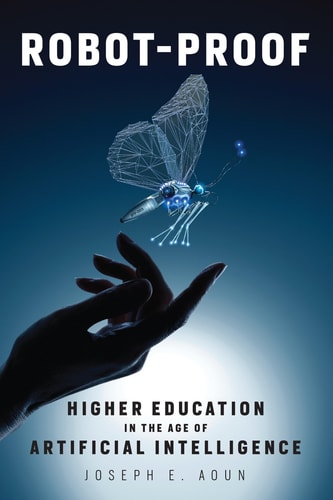
Robot-Proof Higher Education in the Age of Artificial Intelligence
0
0
As an Amazon Associate and affiliate partner, Menrva Books earns from qualifying purchases. Learn more
Author Description
How to educate the next generation of college students to invent, to create, and to discover—filling needs that even the most sophisticated robot cannot. Driverless cars are hitting the road, powered by artificial intelligence. Robots can climb stairs, open doors, win Jeopardy, analyze stocks, work in factories, find parking spaces, advise oncologists. In the past, automation was considered a threat to low-skilled labor. Now, many high-skilled functions, including interpreting medical images, doing legal research, and analyzing data, are within the skill sets of machines. How can higher education prepare students for their professional lives when professions themselves are disappearing? In Robot-Proof, Northeastern University president Joseph Aoun proposes a way to educate the next generation of college students to invent, to create, and to discover—to fill needs in society that even the most sophisticated artificial intelligence agent cannot. A “robot-proof” education, Aoun argues, is not concerned solely with topping up students' minds with high-octane facts. Rather, it calibrates them with a creative mindset and the mental elasticity to invent, discover, or create something valuable to society—a scientific proof, a hip-hop recording, a web comic, a cure for cancer. Aoun lays out the framework for a new discipline, humanics, which builds on our innate strengths and prepares students to compete in a labor market in which smart machines work alongside human professionals. The new literacies of Aoun's humanics are data literacy, technological literacy, and human literacy. Students will need data literacy to manage the flow of big data, and technological literacy to know how their machines work, but human literacy—the humanities, communication, and design—to function as a human being. Life-long learning opportunities will support their ability to adapt to change. The only certainty about the future is change. Hig
Menrva's Summary
THE THESIS
The core question of this book is how to equip college students with the skills necessary to thrive in a future where artificial intelligence and automation are increasingly capable of performing tasks previously done by humans. Joseph E. Aoun, president of Northeastern University, argues that traditional higher education needs a fundamental shift to prepare students for a labor market transformed by AI. He proposes a new discipline called 'humanics,' which focuses on developing human strengths like creativity, critical thinking, and emotional intelligence, rather than solely imparting technical knowledge. This approach aims to cultivate a mindset that allows individuals to invent, create, and discover, filling societal needs that machines cannot. The framework emphasizes data literacy, technological literacy, and human literacy to ensure graduates can adapt and contribute meaningfully throughout their careers.
THE SCOPE MAP
- An analysis of the impact of artificial intelligence and automation on the job market and the skills required for future professions.
- A proposal for a new educational discipline, 'humanics,' designed to foster creativity, critical thinking, and adaptability.
- The three key literacies for the future: data literacy, technological literacy, and human literacy (encompassing humanities, communication, and design).
- Strategies for lifelong learning to help individuals adapt to continuous technological change.
- A framework for higher education institutions to reimagine their curricula and pedagogical approaches.
THE AUTHORITY PERSPECTIVE
The book is regarded as a forward-thinking examination of the challenges and opportunities presented by artificial intelligence in higher education. It is praised for its clear articulation of the need for a new educational paradigm that prioritizes uniquely human skills. The proposed 'humanics' framework is seen as a practical approach to preparing students for a rapidly evolving professional landscape. The emphasis on lifelong learning is highlighted as crucial for navigating future career uncertainties.
Page Count:
210
Publication Date:
2018-08-14
Publisher:
MIT Press
ISBN-10:
0262535971
ISBN-13:
9780262535977
Non-Fiction
Business
Science & Technology
Higher Education
Future of Work
Education Policy
Technology
Community Tags
Similar Books